

Election update: I’ll be joining the Fox32 Chicago election desk all night on Tuesday, Nov. 3 with analysis of local, state, and national races. Tune in from 6-10 p.m. CT to follow along. Haven’t voted yet? Find your polling place hours and location here.
Tuesday is Election Day. And while the nation waits to see whether the balance of power tips in Congress, many races that directly shape Chicagoans’ lives sit further down the ballot.
Here are the four most important questions for Chicagoans to watch: both within the city and across the state.
1. Will Mayor Brandon Johnson and the Chicago Teachers Union lose control of Chicago Public Schools?
For the first time in history, Chicagoans will choose a fully elected school board: 20 district seats plus the citywide presidency.
While some outside groups will have spent more than the Chicago Teachers Union by Nov. 3, the most dominant special interest group in this election is undoubtedly the CTU: Its political leadership selected most of the board incumbents running for election (via their appointment by Mayor Brandon Johnson, a former CTU organizer) and heavily influenced the board structure itself, including the district maps.
On Tuesday, anything less than an 11-member board majority will be a remarkable loss for CTU’s political leadership.
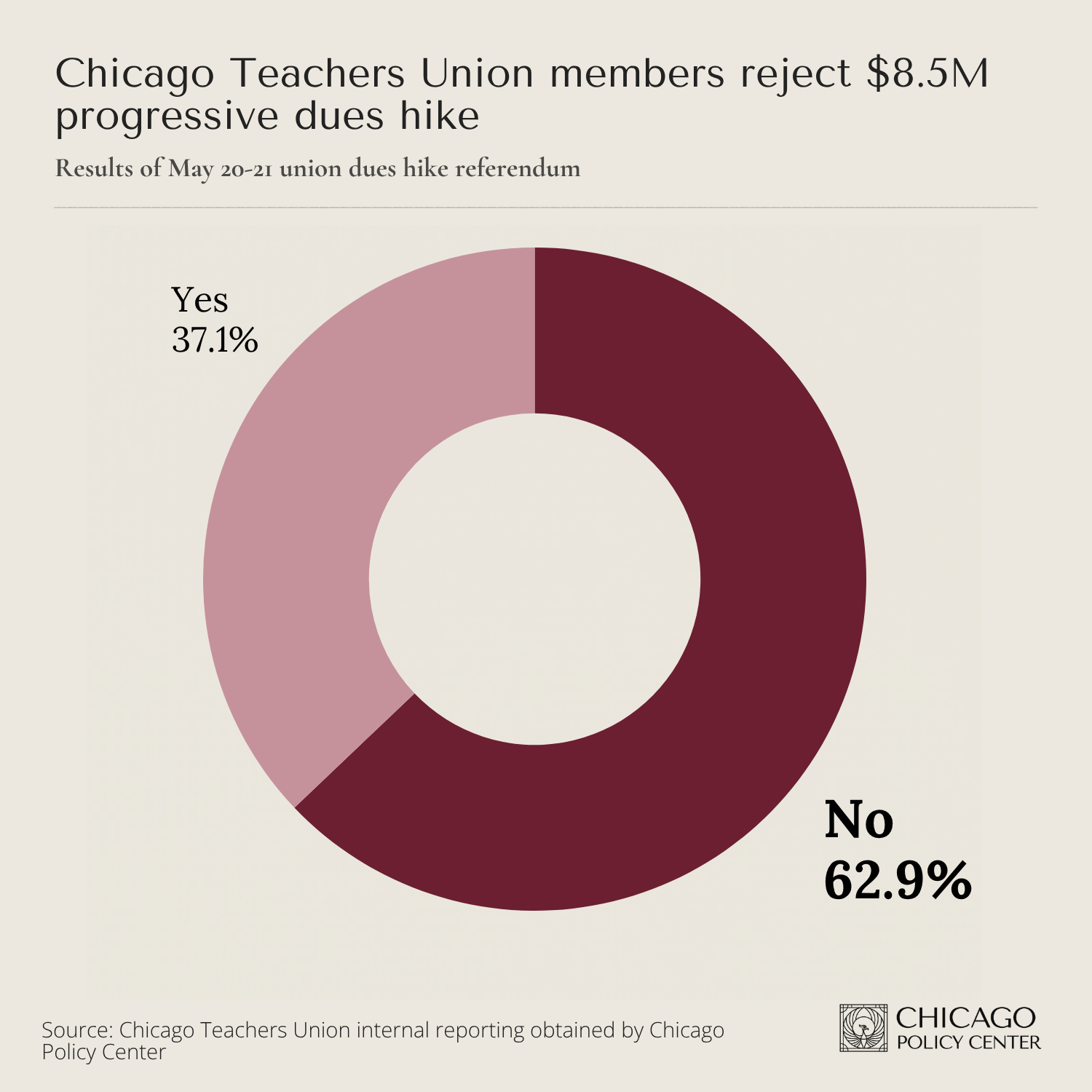
The CTU and its affiliates have spent more than $2.2 million across 18 school board candidates. You can find which candidate the union is backing in your district here. And that spending would likely have been much higher if not for teachers overwhelmingly rejecting a proposed $8.5 million dues hike. In the 2024 elections for the partially elected school board, the union and its affiliates spent $2.8 million on 10 candidates.
Whether candidates independent of CTU can exceed a simple majority and win a 14-vote supermajority will likely come down to these five swing races and the presidency:1
District 1B | Northwest Side: Michell Pierre vs. Claudia Peralta (CTU)
District 3B | West Side: Carlos Rivas vs. Jason Donés (CTU)
District 4A | North Side: Ellen Sherratt vs. Angel Alvarez vs. Karen Zaccor (CTU)
District 6A | Near North Side: Isaiah White vs. Brenda Lee Anderson vs. Anusha Thotakura (CTU)
District 9B | Southwest Side: Therese Boyle vs. Katherin Dunneback (CTU)
In the citywide race for board president, a win for either Jessica Biggs or Victor Henderson would be a rebuke of CTU’s former political director, Hilario Dominguez, whose closing argument has been overshadowed by controversy.
2. Will Republicans lose their last seat on the Cook County Board?
Cook County’s 17th District, which covers a wide stretch of the western and southwestern suburbs, has elected Republicans since 1994. It is now the only Republican seat on the 17-member Cook County Board. Commissioner Sean Morrison, the board’s lone Republican since 2022, isn’t running again. He cited “the limits of what one voice can realistically achieve” on a board so lopsided. He held the seat by fewer than 2,800 votes in 2022.
Former Commissioner Liz Gorman, who held the seat from 2002 to 2015, wants it back. Her opponent is Democrat Elyse Hoffenberg, the Lyons Township clerk, who recently drew international headlines. If Hoffenberg wins, Democrats will hold all 17 seats, and the county’s $10 billion-plus budget will be negotiated without partisan opposition on the board.
3. How many votes can an independent candidate for governor pull from JB Pritzker and Darren Bailey?
Illinois Gov. JB Pritzker is on track to win a rare third term as governor, running against a candidate so weak that Pritzker spent $35 million in 2022 in hopes of facing him: Republican Darren Bailey.
One difference between the 2022 Pritzker-Bailey contest and this year’s is the emergence of independent candidate Collin Corbett, a former Republican consultant, who will appear on the statewide ballot.
Corbett has openly discussed his goal of hitting 10-15% of the suburban vote share, forcing candidates going forward “to compete for the middle again.”
4. How will voters respond to $158 million in sales tax referenda for school facilities?
With cost of living dominating the polls, voters in four Illinois counties will decide whether to raise their sales tax by 1% to fund school facilities spending.
The biggest ask is in Lake County, where a 1% countywide tax would raise an estimated $122 million a year, about $1.2 billion over a decade, for school buildings, school resource officers and mental health staff. It would push the sales tax as high as 10.25% in some Lake County communities.
Voters in Adams, Crawford and Tazewell counties face the same question. Tazewell voters have already rejected it four times since 2009. Statewide, voters have turned down this tax in nearly 62% of the 154 times it’s appeared on a ballot.
In the news
Chicago budget and bankruptcy: I joined Fox32 to break down Brandon Johnson’s proposed budget and a recent conference on the question “What if Chicago goes bankrupt?” hosted by Yale Prof. David Schleicher.

Mincing Rascals: I joined the Mincing Rascals podcast on WGN Radio to break down the final days of election season (Apple Podcasts, Spotify).
A supermajority consists of 14 of the 21 votes on the board. In other words: a supermajority is 13 board members with the president, or 14 board members without the president.