

Frederick Douglass learned to read in secret.
He understood from a young age that literacy was, in his words, “the pathway from slavery to freedom.”
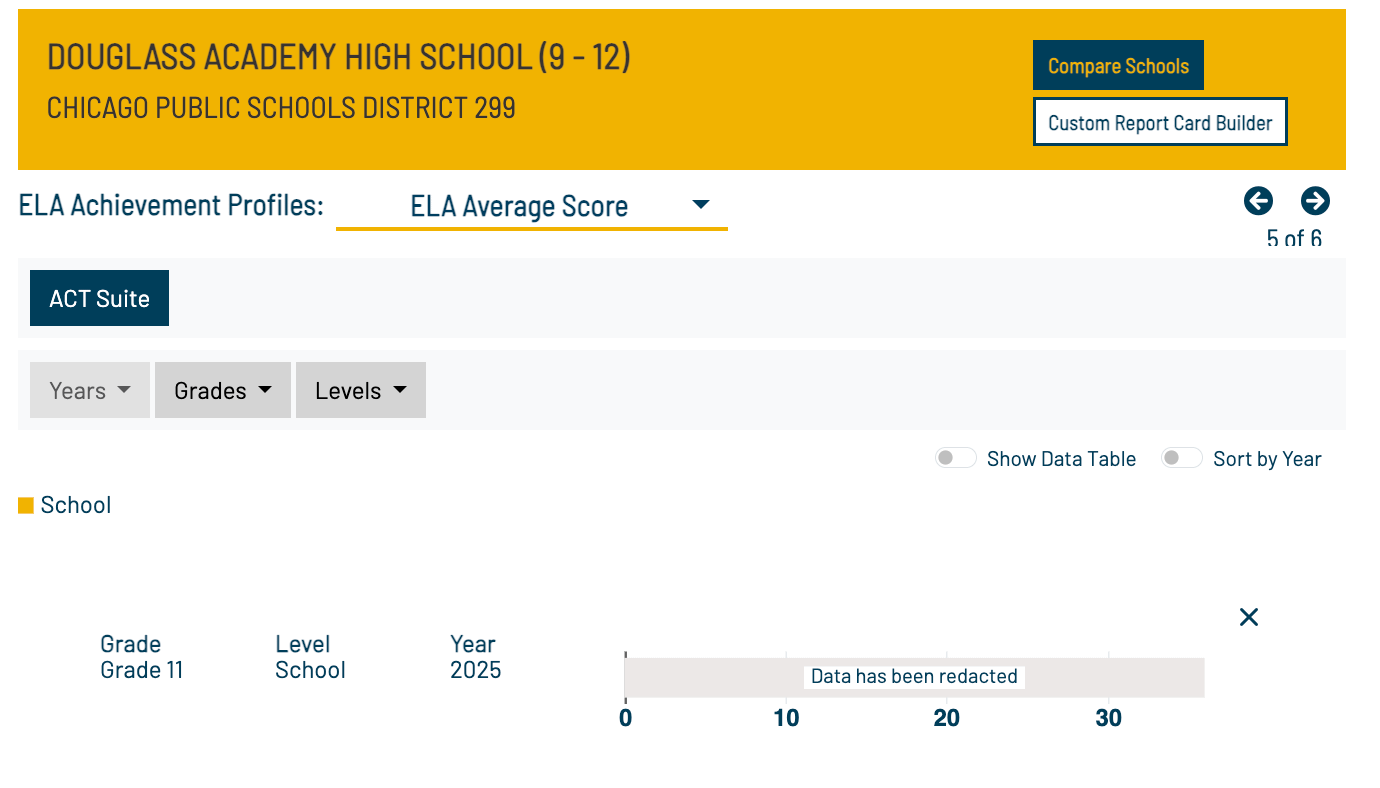
But at Frederick Douglass Academy High School in Chicago, the school is so under-enrolled that Illinois cannot publicly report how many of its students read proficiently. There simply aren’t enough tested students to publish the results without risking their anonymity.1
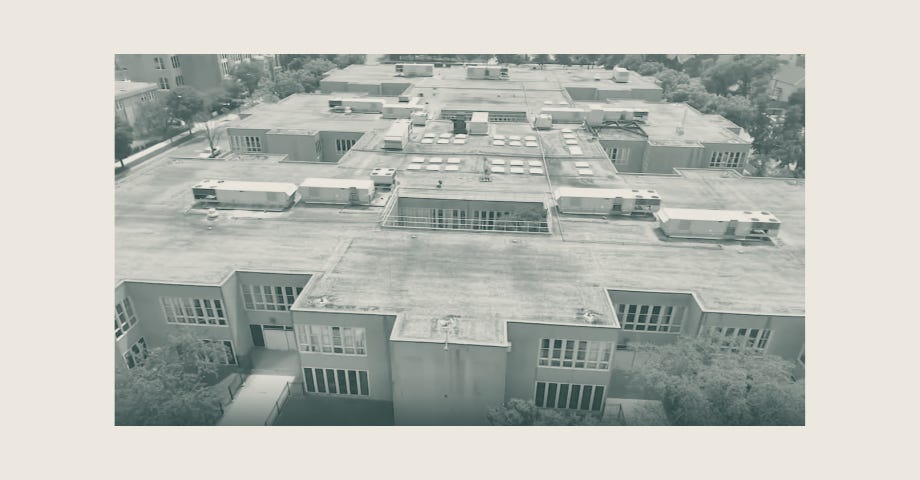
Douglass Academy has 47 classrooms built to serve 1,008 kids. But only 27 students are enrolled there.
At 3% utilization, it is the emptiest big-city school in the country, according to Chicago Policy Center research.2
Meanwhile, CPS personnel records show Douglass currently employs 28 full-time staff members.3
In a district that once served nearly 600,000 students and now serves 312,000, and where one-third of school buildings sit at least half empty, Douglass illustrates the consequences of poor facilities planning: fewer opportunities for students and higher costs for taxpayers.
Empty schools harm students
If a student in Illinois misses more than 10% of school days in a year, they are considered chronically absent. At Douglass, 100% of seniors are chronically absent.
And while the state couldn’t report test scores for the most recent school year, not a single 11th-grade student at Douglass could read or perform math at grade level in the 2023-2024 school year.
This isn’t due to underfunding. In the 2023-24 school year, Douglass spent $93,000 per student.
The real issue is simple: Research has long shown that very small high schools struggle to provide the breadth of academic courses and extracurricular opportunities available at larger schools.
An analysis published by ProPublica and Chalkbeat found the level of under-enrollment at CPS schools like Douglass deprives students of clubs, sports, and other extracurriculars critical to a healthy learning environment.
So what should district leaders do about it?
Addressing empty schools
Chicago Mayor Brandon Johnson and the Chicago Teachers Union have argued the solution to Douglass’ problems is the Sustainable Community Schools model.
But the results are in at eight CPS high schools that have used this model since 2018: proficiency and enrollment have continued to decline, while spending and absenteeism are up.
Today, 47 Chicago schools are operating at one-third capacity. That’s double the number the district faced in 2013 when it closed 50 schools.4
But Chicago is hardly alone.
Declining enrollment in big-city districts across the country has forced leaders to rethink their facilities planning to better meet students’ needs:
The Philadelphia school board approved the closure of 17 schools after experiencing a 12% drop in enrollment over the last decade, and launched a Facilities Data Dashboard to help “develop recommendations on which buildings to maintain, modernize, co-locate, repurpose, or close.”
San Antonio schools commissioned a study on building capacity in 2023 and have since voted to close 15 campuses, repurposing four.
New York City closed two schools and merged 16 schools in recent years, while opening 28 new schools.
In Columbus, the Community Facilities Task Force made recommendations to the school board, leading to board approval on five school closures or consolidations starting in the 2026-27 school year.
It’s past time for Chicago to start planning smarter.
A better path forward
The Chicago Policy Center’s CPS Excellence Agenda provides a Day 1 work plan for Chicago school board candidates hoping to win their elections this November.
One key recommendation: Convening a Blue Ribbon Commission for CPS facilities planning, which should:
Assess the current facility footprint.
Establish an ongoing framework for optimizing school facilities for student success, including core principles of school utilization, neighborhood coverage, and model school staffing.
Set a consistent minimum standard for schools in terms of enrollment and performance, as well as a consistent “high bar” standard that triggers school-model replication.
Compare CPS’ capital financing ability to other large districts.
The name Frederick Douglass should stand for the expansion of educational opportunity, not the preservation of an empty building.
Chicago students deserve the opportunities his legacy demands.
In the news
I joined the Mincing Rascals on WGN this week to discuss Chicago policing, the Illinois secessionists, and more (Apple Podcasts, Spotify).
Illinois was the only state admitted to the union in 1818, most likely the same year Douglass was born, yet Douglass Academy is the only school in the state bearing his name. There should be more.
This analysis included school districts covering the 15 most populous U.S. cities.
This includes 13 teachers (eight regular, five special education); two administrators (interim principal, assistant principal); two special-ed classroom assistants; five counseling/support roles (school counselor, college/career coach, conflict resolution specialist, restorative justice coordinator, technology coordinator); four security/operations personnel (two school security officers, one senior security officer, plus a porter); and two clerical/food (school clerk, high school lunchroom manager).
Part of the backlash to the 2013 school closures was the inclusion of a school closure moratorium in the collective bargaining agreement between the Chicago Teachers Union and CPS, which expired in 2019. Instead of renewing the moratorium clause inside subsequent union contracts, state lawmakers included a temporary moratorium on school closures in the state law establishing a newly elected school board for CPS. That moratorium expired in 2025. The CPS board voted to extend that moratorium through the 2026-2027 school year.
600,000 —>312,000 is a stunning statistic. It would be interesting to chart that against the eroding student population, growth in charter school enrollment, growth in private & parochial school enrollment and growth in home schooling.
$93K/student is roughly double the annual tuition at some of our most elite private schools. It is scandal, an insult to common sense, and a squandered opportunity to do better for those students.
Chicago Mayor Brandon Johnson keeps talking about affordable housing, so here is his chance to shutter underutilized school buildings and have them converted to condos for area residents.