

Election update: Early voting is now open in all 50 wards for the Nov. 3 Chicago school board elections. Find your polling place here. Don’t know who’s on your ballot? Click here.
Mayor Brandon Johnson introduced his $17.6 billion 2027 budget to the City Council on Oct. 21.
He calls it a “Fair Share” budget, a callback to Harold Washington’s 1986 proposal that bears little resemblance to the city’s modern spending plans. Johnson says his budget makes giant corporations and Big Tech pay.
The budget fills an $882 million hole with $427 million in new taxes and fees, $231 million in one-time money and $61 million in rosier revenue estimates. It also borrows $481 million to pay police misconduct settlements.
The council has until Dec. 31 to pass a budget. Johnson and all 50 aldermen face voters in February.
Here are four ways Johnson’s “fair share” budget hits the little guy.
1. The head tax is window dressing
Harold Washington proposed cutting the city’s head tax in his 1986 budget: from $5 per month per employee to $4.
The head tax no longer exists in Chicago. But Johnson proposes bringing it back, at an even higher rate than his failed proposal to do so last year.
2026 proposal: $21 per employee per month, for employers with more than 100 workers.
2027 proposal: $25 per employee per month, for employers with 125 or more workers, with a credit for employees who work at sites in disadvantaged areas.
Johnson’s proposal would create a jobs-specific tax bill five times higher than any peer city.
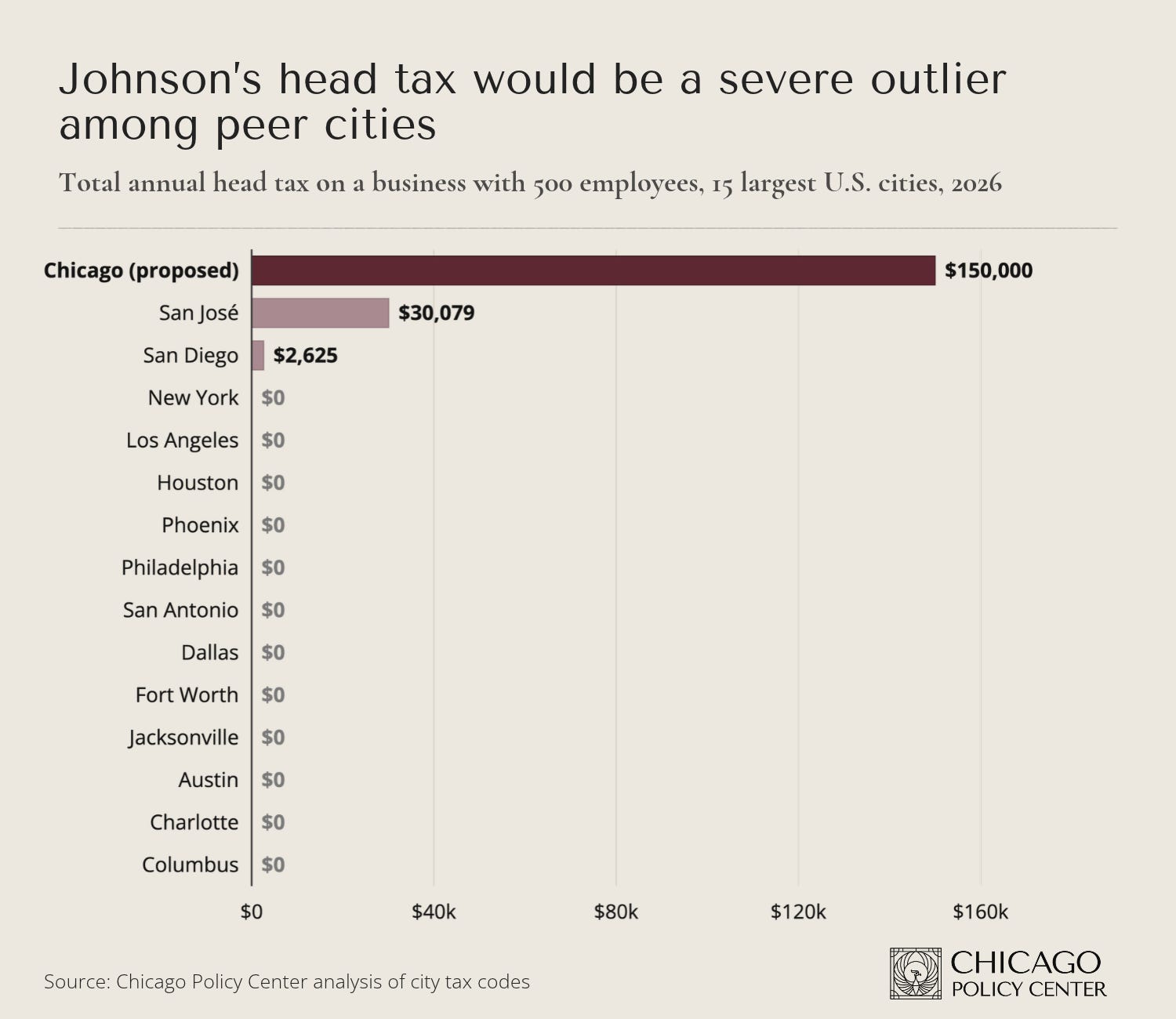
The tax would raise an estimated $114 million. And it is highly unlikely to pass. Twenty-nine aldermen signed a letter before the budget dropped saying no head tax, a strong majority of City Council.
The head tax proposal is kayfabe. Johnson gets to play the people’s champion grappling with “giant corporations.” The city’s largest employers are cast as the heel. But everyone knows how the match ends: a majority of the council has already said no. And if the council did indeed pass it, everyone would pay. A tax on each job is a tax on hiring.
Ald. Bill Conway, 34th Ward, said on WTTW it would effect about 376,000 jobs, roughly a third of the city’s private-sector workforce.
Chicago cannot afford a penalty on growth. A new Civic Committee of the Commercial Club of Chicago report found:
The Chicago region’s economy grew 1.5% a year from 2010 to 2023. The 15 largest metros averaged 2.9%. Chicago ranked 14th of 15.
The region’s population did not grow at all from 2010 to 2024. Peer metros grew 1.1% a year.
A city that does not grow can’t outrun its problems.
Johnson’s own plan admits as much. He calls it the “Equitable Employer Tax,” and refunds the full tax for jobs located in census tracts the city designates as disadvantaged. Budget Chairman Jason Ervin said on WTTW the credit is meant to “drive investment into those areas.”
But that only works if employers decide where to put jobs based on the tax.
If a $300-a-year charge per worker can pull jobs to the South and West sides, it can also push them to Schaumburg, Oak Brook or Indiana.
2. The real tax hikes land on customers and small businesses
The head tax gets the headlines. But that’s not where most of the new money is coming from.
Johnson wants to raise Chicago’s personal property lease transaction tax from 15% to 20%. That is estimated to bring in an extra $235 million, more than half of all the new taxes and fees in the budget. He calls it a tax on Big Tech because it covers cloud software.
But Big Tech doesn’t really pay it. The law puts the tax on whoever leases the property or uses the software. Microsoft, Salesforce, Anthropic and Amazon Web Services simply add it to the invoice. And it’s not just software. The tax hits:
Copier and equipment leases
Tool rentals at Home Depot
A tux for prom
A bouncy castle for a block party
Fox32’s Brandon Pope asked Johnson about the impact of the lease tax on small businesses in his interview last week.
The fine print makes this tax worse for startups. Johnson’s revenue ordinance cuts the lease tax exemption for small, new businesses. Today a firm under $25 million in receipts and less than 60 months old pays no lease tax on cloud software. Johnson’s plan drops that to $4 million and 36 months.
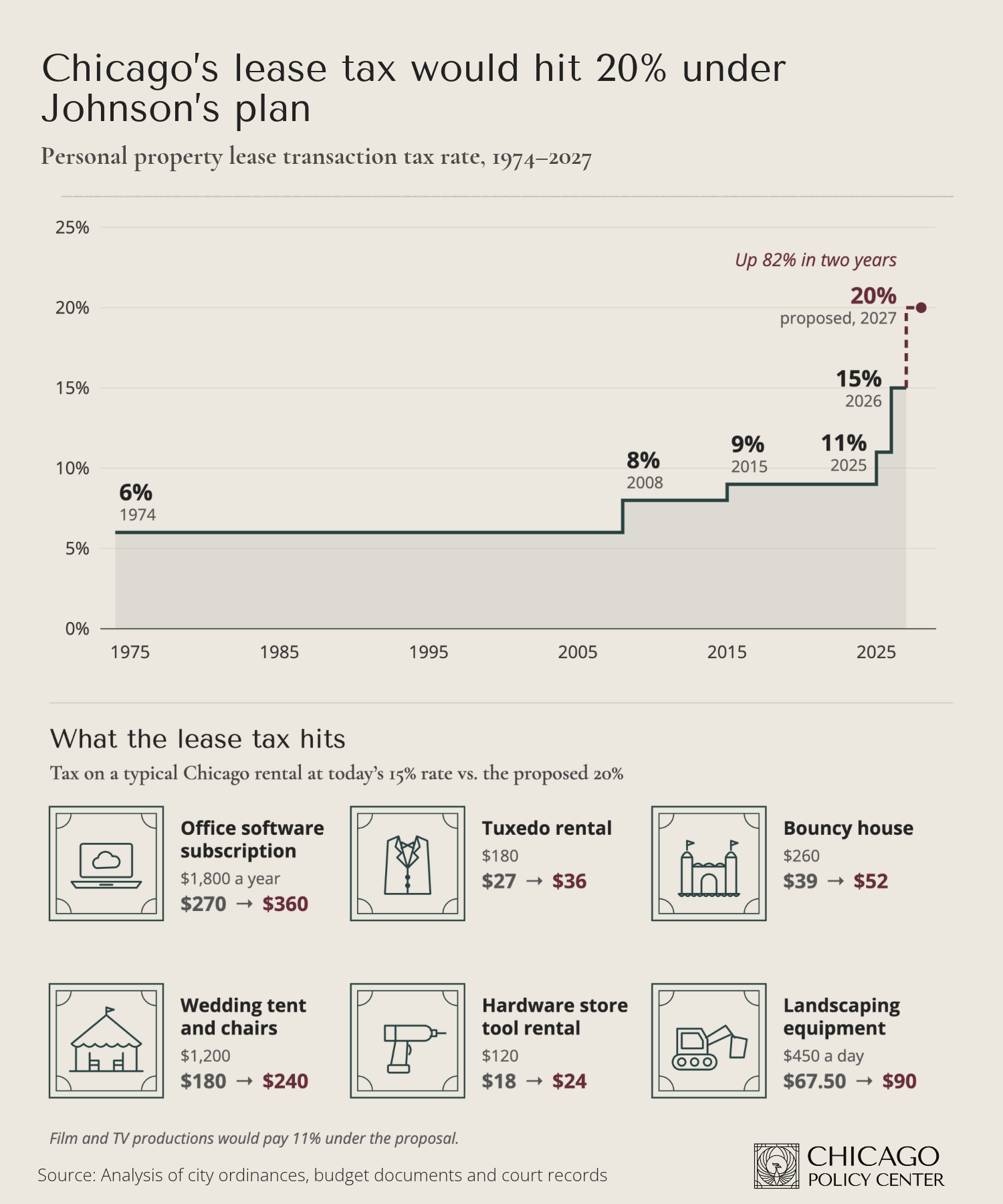
Johnson’s plan also goes back on a promise. Last year the council raised the lease tax from 11% to 15% and wrote into law that the rate “shall not be increased prior to January 1, 2028.” Johnson’s ordinance strikes that sentence.
No other big city does this. Chicago is the only one of the nation’s 15 largest cities with a standalone tax on leases. The other 14 tax leases at their normal sales tax rate, between 7.5% and 10.25%. Chicago’s lease tax is a separate city tax, and Illinois exempts Chicago leases from the state’s lease tax. So Chicago’s 15% is the whole tax on the lease, and the city keeps all of it. In the other 14 cities, the city’s share of the tax on a lease runs from zero to about 4.5%.
Also note: Not everyone goes to 20%. Johnson’s ordinance cuts the rate for film and television productions to 11%.
Why is a TV production’s “fair share” smaller than a landscaper’s?
A film crew renting cameras and lighting rigs for a Netflix series would pay an 11% tax. A neighborhood landscaping company renting a skid steer and a trencher for the spring season would pay 20% tax.
And the lease tax is not the only hike aimed at regular people:
Sports betting: the city tax doubles, from 10.25% to 20%.
Liquor: the tax on alcohol bought at a store doubles, from 1.5% to 3%.
Packages: a new 15-cent tax on most types of home deliveries.
Loading zones: from $110 to $350 a year outside downtown.
Driveway permits: from $10 to $50.
Licenses: massage businesses and pharmaceutical reps go to $1,000.
Of the $427 million in new revenue, $114 million comes from a corporate head tax the mayor has not done the political work to pass, and almost certainly won’t.
Far more, $313 million, comes from taxes, fines and fees that will hit everyday Chicagoans and small businesses.
3. It continues the city’s worst budgeting practices: covering recurring operating expenses with borrowing and one-time revenue
Johnson wants to borrow $481 million to pay police misconduct settlements. WTTW reported the breakdown:
$261 million for 16 lawsuits tied to former Det. Reynaldo Guevara
$120 million in settlements the city already owes
$100 million set aside for lawsuits that haven’t been settled yet
This comes one year after the council approved $283.3 million in borrowing for the same purpose. The city’s CFO estimated that bond alone would cost about $52 million in interest over five years.
The city budgets about $82 million a year for police settlements. It paid $107.5 million in 2024 and more than $285 million in 2025. It has overspent that line in every year since 2010 except two, according to a Chicago Tribune analysis.
Paying for these settlements with bonds is borrowing for operations.
Budget Chairman Jason Ervin, 28th, defended this on WTTW. Charging current taxpayers all at once is not prudent, he said, so the city should “spread the pain.” Spreading the pain means future taxpayers are on the hook for the settlement plus interest.
Johnson’s own staff used to say this. Alyx Goodwin is now the mayor’s senior policy adviser on community safety. In a 2020 webinar for the Action Center on Race and the Economy, she attacked this exact practice as “police brutality bonds.”
“We see this very specifically as Wall Street profiting from police violence,” she said.
The council recently came within one vote of making this harder. Ald. Marty Quinn’s ordinance would have required 30 votes, three-fifths of the council, to approve new borrowing. Johnson vetoed it. On Oct. 14 the override failed 33-17, one vote short of the 34 it needed.
The budget also uses $231 million in one-time that won’t be there next year:
$118 million from a TIF surplus sweep
$75 million from the latest parking meter deal
$38 million from the Catalyst Fund
4. It ignores efficiencies the city paid consultants to identify
Chicago’s spending problem is not a mystery. City spending is up $4.1 billion since 2019, a 46.5% increase.
Pensions: up $1.54 billion, or 113%.
Non-pension personnel: up $1.59 billion.
Budgeted positions: about 900 fewer than in 2019, including 1,253 fewer police.
Spending rose by billions while the city budgets fewer workers. This means taxpayers are paying more and getting less.
But the city already paid consultants to find ways to do more with less. Ernst & Young identified up to $1.4 billion in potential efficiencies. Johnson’s 2026 budget used about $12 million. The city spent $3.2 million on the report.
Last week, Ald. Anthony Beale, 9th Ward, said on WTTW that none of the EY recommendations have been implemented. Johnson’s 2027 plan adds about $288 million in Corporate Fund spending instead.
The worst of both worlds
Johnson’s budget rollout attempted to make villains out of the city’s biggest employers. But his proposal sends the bill to everyone else.
Fixing Chicago’s structural budget problems will require a grand bargain. Labor gives up some positions, pay raises and benefits. And the city raises some new revenue, which overwhelmingly goes to paying down debt faster and ending the borrowing for operating costs. That would be closer to a “fair share” budget for everyone.
The council has until Dec. 31 to pass a budget. They’d be wise to start from scratch.
In the news
I joined the Mincing Rascals podcast on WGN Radio to discuss Johnson’s budget, last week’s piece on Hilario Dominguez, and more (Apple Podcasts, Spotify). My “green light” recommendation: Nathan Fielder’s “The Curse” (2023).