

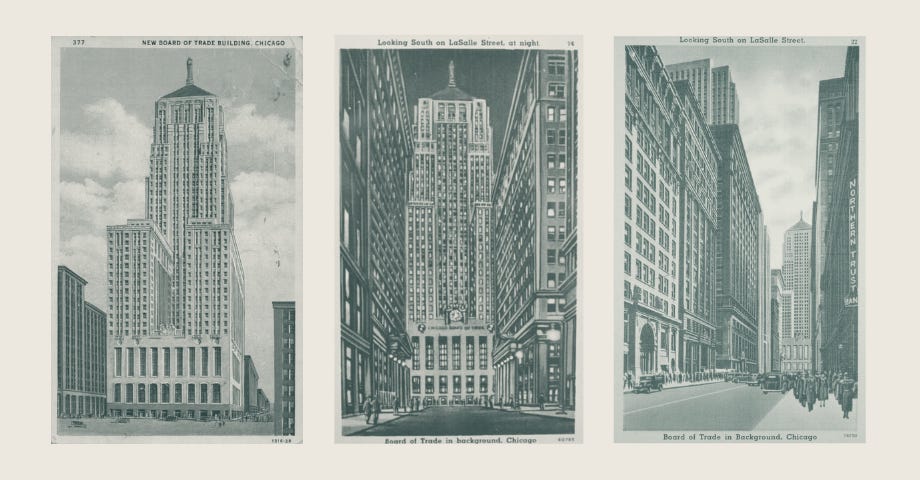
The canyon of LaSalle Street grew dark.
Thunder clapped. The wind howled. Amber-orange street lamps flicked on. And lightning flashed against the facade of the Chicago Federal Reserve, bouncing off its six-story Corinthian colonnades of Indiana Limestone.
But inside the Chicago Board of Trade, nobody looked up.
It was 2:30 in the afternoon. Markets wouldn’t close for another half-hour.
At an options trading firm on the fourth floor, dozens of traders sat glued to their monitors, clicking keys as quickly as rain hit the pavement.
Many of these traders were recruited to Chicago from faraway lands. Among their ranks were math olympiad champions, chess grandmasters, and physics professors.
But Frank was different. He grew up on the Southwest Side and started as a pit runner at the Board of Trade when he was 14 years old. He carried a thick Chicago accent.
Another thunderous boom rang out through the Loop. Frank turned his head. And he saw the majesty of a Chicago summertime thunderstorm, framed by 40-foot-tall windows.
He shouted out.
“It’s a [expletive] monsoon!”
What made Chicago rich
My first week on the job, Frank told me why those north-facing windows were so massive.
“They built ‘em like that for the grain.”
When the current Chicago Board of Trade building opened in 1930, the “cash grain” market was still important. If a miller wanted to buy a specific shipment of wheat or corn arriving by train, they needed somewhere to inspect physical samples. But incandescent lightbulbs cast an inaccurate color. So like an art studio, the Board of Trade needed north-facing windows with consistent, indirect sunlight throughout the day.
Instead of oil paintings, 36 long tables for grain inspection once sat beneath the same windows through which Frank watched the thunderstorm, 85 years later.
Those tables are no longer needed. And the reason why stands among Chicago’s greatest contributions to the world: it was home to the largest exchange in the West to transform physical grain into a commodity—graded, standardized, and reduced to a number that could be traded, modeled, and hedged.
This solved a trust problem for millions of people. Farmers could lock in a price before the harvest instead of gambling on a bad season. Millers could lock in a cost months before they needed the wheat. And grain merchants could borrow against a shipment without a banker ever laying eyes on it, because the grade stamped on the receipt was trusted as collateral.
It made Chicago rich.
Not just for the traders on LaSalle Street, but also for the immigrants, laborers, and tradesmen the boom employed. It is among the core reasons why from 1870 to 1900, Chicago grew faster than any city in world history.
The grain is long gone from the Chicago Board of Trade. So are pit traders like Frank. But a new generation of innovative financial businesses has been honoring the legacy of Chicago as a modern trading hub. And they are now butting up against a local culture older than Chicago’s trading pits: Illinois politics.
Springfield is threatening the city’s legacy of financial innovation. And the bounty that comes with it.
“First we get the money”
Allies of Chicago Mayor Brandon Johnson released a report the week of his inauguration in 2023 entitled, “First We Get the Money.” Among $12 billion in tax increase proposals highlighted by the report was a tax on every transaction at the Chicago Board of Trade.
Illinois Gov. JB Pritzker stepped in immediately to calm fears of a business exodus.
“We have a terrific financial industry in the state of Illinois,” the governor told Bloomberg at the time.
“We all understand that a financial transactions tax simply would encourage them all to … move their servers across the borders of the state to some other state.”
But last week, the governor signed into law a new transaction tax on digital assets. The first of its kind in any state.
New tax on digital asset transactions
Pritzker signed the Illinois state budget last week. It included the Digital Asset Tax Act, a 0.2% tax “on the value of any digital asset exchanged, transferred, or stored on a customer’s behalf by a broker doing business in Illinois.”
Notably, this tax was introduced just hours before state lawmakers passed the $56 billion state budget at 4:13 a.m. on Monday, June 1.1
Industry leaders locally and across the country were shocked:
“This Illinois law is remarkably bad - it will end up hurting the state, kill jobs and push innovation out of the state.” – Brian Armstrong, Co-founder and CEO of Coinbase
“This is like taxing changing your bank password.” – Hayden Adams, founder of Uniswap
“Chicago has a real opportunity to lead in stablecoins / trading infra / programmable payments. There are countless startups and companies in the state creating high $$$ jobs and building the next generation of financial infrastructure. Most people won’t notice a 0.2% tax on a handful of transactions. But if the future is millions of machine-to-machine payments powered by stablecoins, every layer of friction matters.” – Landon Campbell, Chicago tech investor
“I would like to remind everyone in crypto law that as defined in the bill, this likely covers all forms of digital money, so if IL is not enforcing this against electronic bank transfers, you should sue.” – Austin Campbell, NYU Stern School of Business Adjunct Professor
“You aren’t taxed if you exchange a stock, bond, or derivative in paper form, but you are taxed if they happen to be recorded on a blockchain? That’s like taxing email.” – Miles Jennings, general counsel for a16z crypto
Illinois commonly relies on “sin” taxes to stitch up budget gaps. Cigarettes, gambling, and alcohol are all politically easy targets for tax hikes. “Crypto” is now among these. The industry has become politically polarized, owing in no small part to members of the president’s family pulling in billions of dollars from it.
But this tax goes far beyond scammy meme coins pushed by politically connected figures. And it goes beyond Bitcoin. It threatens to destroy an ecosystem of financial businesses in Chicago relying on new technology to better serve their customers.2
To an average person, a 0.2% tax seems minuscule. But to Chicago businesses built on facilitating billions of financial transactions using modern technology, it is a monsoon.3
The tax is only estimated to bring in $60 million. That is a rounding error in the Illinois budget. But because no other state imposes a tax like this, Illinoisans should not be surprised if this costs the state more tax revenue than it brings in, as businesses in this space decide to invest their time and talent elsewhere.
Unless something changes.
What you can do to stop the digital asset transaction tax
This tax does not take effect until Jan. 1, 2027. And Illinois lawmakers will return to Springfield for veto session this fall.
The tax will almost certainly be in court before then. But with enough engagement from constituents, Illinois state lawmakers could be convinced to make reforms on their own.
To tell your Illinois state representative to repeal the digital asset transfer tax, click here.
The U.S. federal government is actively overhauling its digital asset tax framework. This is one reason Illinois policymakers should have taken more time to evaluate this proposal.
In 2021, Pritzker joined Coinflip, a large Bitcoin ATM operator, in announcing a 44,000 square foot headquarters at the Old Post Office. “We are … working to build a cryptocurrency regulatory framework that’s best in the nation,” Pritzker said. “And so we are, frankly, open for business for everyone that wants to be in this industry.”
This is not a tax on profits or gains, but simply a tax on transfers, even for moving assets between your own wallets. It’s also double taxation, as Illinoisans already pay taxes on income and gains.