


Chicago Magazine ran a provocative piece by Edward McClelland last week, titled “The Progressive Slide.”
“It wasn’t all that long ago that progressives had the momentum on City Council,” McClelland wrote. “Fast-forward to this March. They are no longer in control of the agenda. Instead, they’re playing defense, trying to protect what they already gained.”
McClelland’s piece centers on Council’s 19-member Progressive Reform Caucus.
But the backslide among six aldermen who are self-described democratic socialists—those who composed what Jacobin described as Council’s socialist wave in 2019—is perhaps more striking. Not only for that faction of the council, but also for the organizing force they represent. Or what is left of it.
In an hour-long interview for the new podcast from Fox Chicago’s Grant Horne, I ran through the rise and fall of Chicago’s democratic socialist political project, and how it compares to those in cities like New York and Seattle.
You can watch the full episode here.
Below are a few excerpts, edited for clarity.
On running as a socialist for Chicago City Council:
Grant: Well, let’s talk about elected people now .. when you see these six [democratic socialist] elected leaders, what comes to mind when it comes to their presence within City Hall?
Austin: What’s so interesting about this dynamic in Chicago [are] the intentions versus the outcomes. What does it look like if your goal is European-style social democracy, but you’re elected to City Council of Chicago? What levers do you really have to bring that about? You don’t have a lot. And in fact, Chicago, even differently than a lot of other big cities, council members very rarely are true legislators. They’re more like customer service representatives in their ward. Most of their time is spent responding to constituent concerns about potholes or tree trimming or parking or sidewalk cafe permits or business signage—sort of ticky-tack things. So one of my arguments for wholesale reform of the structure of government in Chicago, which is a deeper conversation, is that even folks who are elected on a pretty far-left platform, they have no way to really do anything that they thought they were running to do and what people thought they were voting on them to do. Again, I think when you’re in City Council, it’s not built to be a true legislative body. So it ends up that a lot of [actions] end up being more performative things—like resolutions, or it could be simply proposing really wacky tax hikes, which that’s not good, that scares people away. Even just the proposal of those things. But they feel like they were elected to maybe push some of that forward.
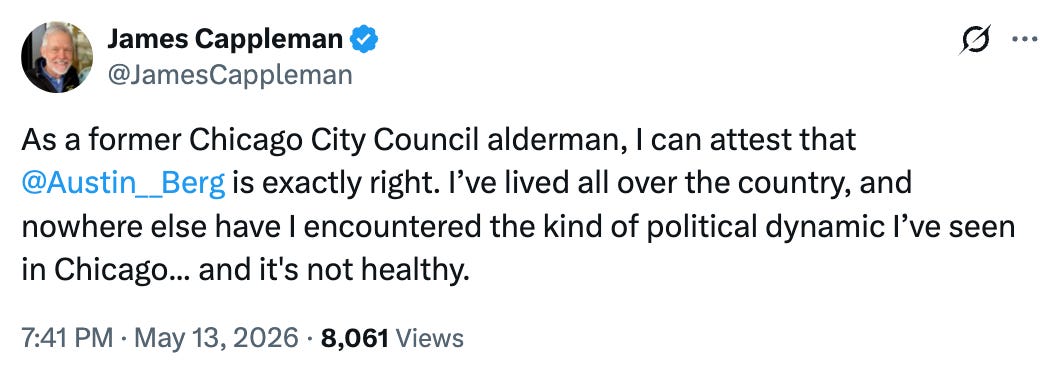
Former Uptown Ald. James Cappleman later weighed in on this argument.
On Chicago Mayor Brandon Johnson and delivering on an agenda:
Austin: We’re at a unique point in Chicago history because there’s never been a sitting mayor who was as unpopular as Brandon Johnson was midway through his first term. And that fractured his coalition tremendously. I think the Chicago Teachers Union is essentially in his corner and nobody else is, including many of the [Democratic Socialists of America, or DSA] members of City Council. So in Chicago, I think that has essentially put things at a standstill. Brandon Johnson has not had major policy changes passed really in the last two or three years in part because of that. He was not able to, once he got into office by a very slim margin, expand his coalition. Rather, partially because of these ideological purity tests, that coalition only shrank after he got into office.
You look at someone like [Seattle Mayor] Katie Wilson when Starbucks and Howard Schultz left—what then? This glib remark: “Bye.” You can get by on that maybe for a couple of days on social media, but then what happens when you have to balance a budget? You’re going to hike property taxes on everybody? Are you going to have to ask the state to pass a new, novel tax on certain types of people? What kind of political capital do you have to get that done? With [New York City Mayor Zohran] Mamdani, you see a ton of interaction between him and the state that’s very interesting because there’s only so much he can do as a mayor. When is Mamdani going to start blaming [New York Gov. Kathy] Hochul? He already has a little bit. When is Brandon Johnson going to start blaming [Illinois Gov.] JB Pritzker? He has a lot. Wilson, I’m not as familiar with, but that will happen. It’s the posture of resistance. That is what the DSA is incredibly good at. But it doesn’t work well when you’re actually in power.
On the political muscle of the DSA in Chicago:
Austin: There is DSA organizing energy, but the money is only going to be able to come from government-sector unions. Members of DSA are not going to be spending millions of dollars on politics. That money is coming from groups like the Chicago Teachers Union. And where I think DSA-like politics are perhaps most effective is in organizing within government-sector unions. Most people are not focused on the politics of their union; they’re just going to work as a teacher or as a bus driver or a train conductor for the CTA. They’re not really thinking about union politics. But if this is your ideology, you can effectively organize a caucus within that union, take over the union, and then you have tens of millions of dollars to play with every year. And that’s what you see in Chicago …
We can vote out Brandon Johnson in Chicago, but none of us get a vote on the president of the CTU, and they’re the ones who are really wielding a ton of money and juice in these elections …
There is a caucus within CTU called CORE—the Caucus of Rank and File Educators. And that was started as essentially a socialist or critical theory reading group within CTU. And it had people like Jackson Potter, Karen Lewis, Stacy Davis Gates, later Brandon Johnson. And that reading group was more sort of affiliated with the types of politics that you would see with a DSA. So I would say birds of a feather for sure, and aligned almost 100% on the types of candidates that they’re backing. So almost every socialist candidate for city council is also endorsed by the Chicago Teachers Union, and gets funding from the Chicago Teachers Union.
On New York City Mayor Zohran Mamdani singling out Citadel CEO Ken Griffin in a viral video promoting his pied-à-terre tax:
Grant: It seems like [Griffin’s] going to move the rest of his New York operation to Miami. So after leaving Chicago and taking a large part of Citadel with him there, it seems like Citadel is just going to be a Miami-based organization … this could be a gigantic one-man rug pull for the city of New York to pay for a lot of these very ambitious things that Mamdani had promised. Is that enough to crater the aspirations of a city? Do you think that Griffin’s move will act as like a domino where it might get more people at least thinking about the process?
Austin: It’s very hard to kill a big city. There are so many advantages. I was just in New York City on Sunday; I rode the Five Boro Bike Tour. It was a 40-mile bike race, they closed down the streets. Mayor Mamdani was doing it. And as you’re riding around New York City, [you are struck by] hundreds of years of accretive human innovation and ingenuity and activity to build what New York City is. You cannot wipe it away with a few political videos. That’s not going to happen. That said, I live in Chicago and I lived here when Ken Griffin lived here and I live here now when he doesn’t. And every highly successful person in Chicago knows Ken Griffin left, and knows why he left, and has empathy for why he left. I’m very grateful for all of the Chicagoans who stay here and make the city better and fight. [But] all of those people, when they look at what Ken Griffin did, say, “Yeah, I get it.” I ride the bike path that Ken Griffin helped pay for on the Lakefront Trail. I go to the museums that he contributed to. He was just an incredible philanthropic force in our city. And having that energy leave and go somewhere else, it’s really sad. Cities shouldn’t discount what happens when those sorts of nodes leave. And that’s really the difficult thing when talking about these really small bands of taxation where it’s like, “everybody over $1 million,” “everybody over $10 million,” “everybody over $100 million.” You lose just a few of those people and it’s sort of a social contagion—like, a lot more could leave. So I don’t think it’s going to tank New York City finances overnight, but the more progressive your tax structure, the more that hurts [when high-earners leave] because those people are bearing a bigger part of the load. That’s why you don’t see that kind of thing in European-style social democracies; it’s a much broader base [paying higher taxes].
On whether to bet on Chicago:
Grant: Last question: are you “short” or “long” on Chicago? I’m long. I think that we have a great infrastructure, we have great natural beauty, we have a great story. We’re a beautiful natural magnet for all the cool people that live in the plains and in the Midwest and in the South. I feel like when the rest of the country becomes uninhabitable because of mudslides or power outages or shorelines or things along those lines, that the Midwest is going to look really “hot” from a real estate perspective, maybe like in the next 10 or 15 years. So that informs my attitude about why I’m long on Chicago. How do you feel?
Austin: I think the climate refugee argument is a form of what I would call “Waiting for Superman” syndrome, where it’s like, “Well, this thing completely outside of our control [as a city] actually is going to break our way and that’ll be our saving grace.” I think I’m actually much more hopeful than that because I agree—I think Chicago is the greatest American city and happens to be the worst governed. And this is a good thing because our problems are man-made problems. We do not have a plague of locusts, we do not have hurricanes, we do not have earthquakes. All of our problems are man-made, which means the solutions are man-made, and those can change much more quickly than natural problems that are working against you and they can be changed. So I’m very long on Chicago.
That and much more in the full interview.
Thank you for the refreshing and logical perspective you bring to our city.