

Election update: Have you requested your ballot for Chicago’s Nov. 3 school board elections? Join more than 3,000 Chicagoans who have requested their ballot here.

Chicago is home to a “pay later” political culture.
As a result, it has the lowest credit rating of any big city in the country. And it is the most financially stressed big city in the county, according to a recent Reason Foundation report.
A new analysis from the Chicago Policy Center shows why this isn’t surprising: no other city makes it so easy for local lawmakers to borrow money.
Encouragingly, City Council last week voted to put a speed bump in place for new borrowing deals, voting 32-15 to require a three-fifths vote (30 alders) to issue debt, up from the current simple majority requirement (26 alders).
But Mayor Brandon Johnson is crying foul.
No other big city places fewer limits on borrowing
In February 2025, Chicago City Council approved an $830 million bond deal 26-23, after Mayor Brandon Johnson cast a tiebreaking procedural vote to advance the measure.
The deal’s severely backloaded payment structure—the city makes no payments on the debt for the first two years, then interest-only payments until 2045—more than doubled the cost of the borrowing, to $2 billion.
This deal and the way it happened would not be allowed in any other major city.
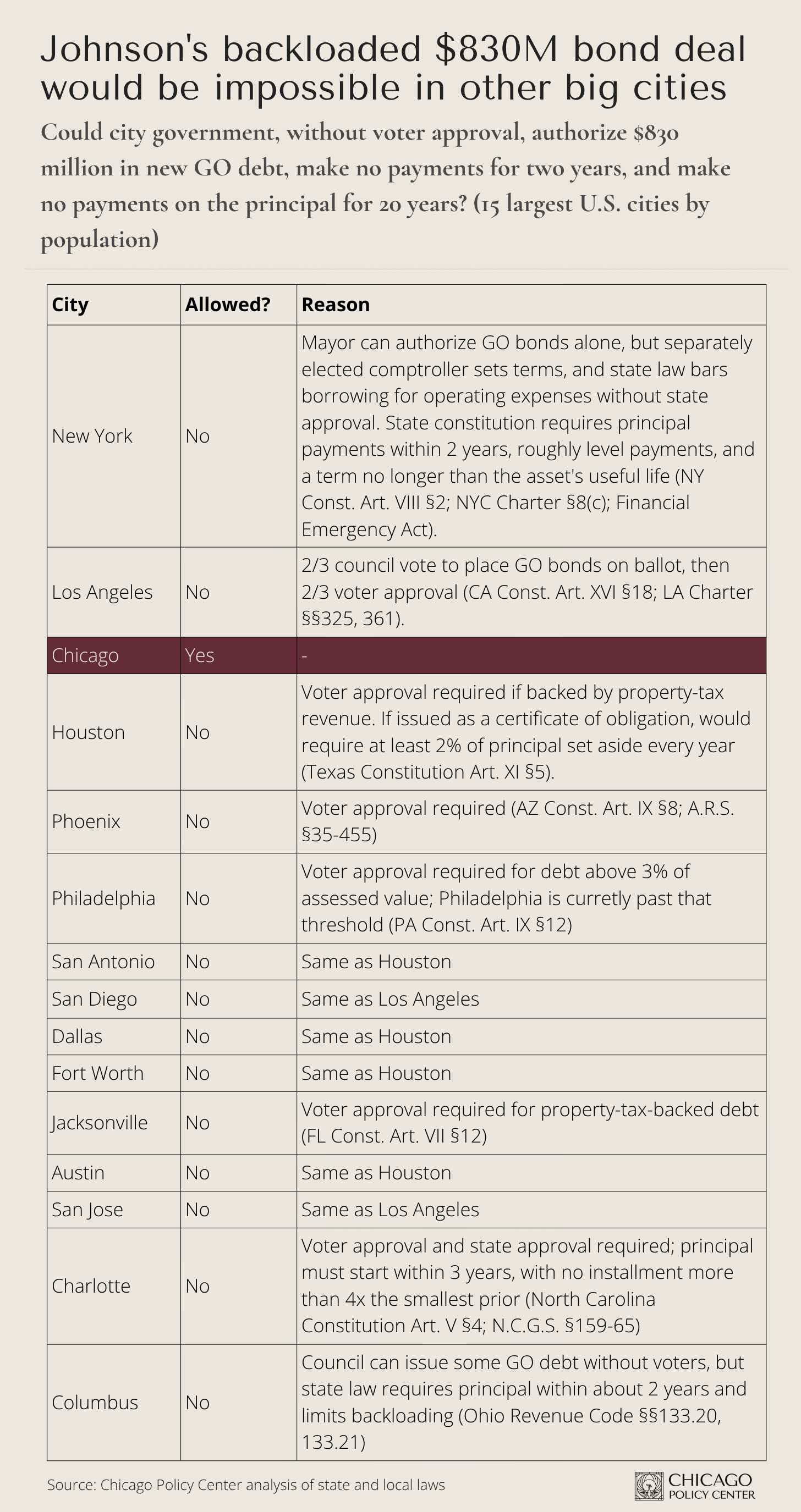
Some notable differences emerge when comparing Chicago’s lack of safeguards with other major cities:
In nearly every big city (12 of the 15 largest by population), all new general obligation debt requires voter approval. This requirement typically lives in the state constitution, with some cities placing additional rules in their charter.
In Los Angeles, San Diego and San Jose, new borrowing requires two-thirds voter approval. And sending that question to voters requires a two-thirds vote of the city council.
In New York, the mayor alone can authorize borrowing, but the state constitution dictates how much the city can borrow, what the money can be used for, and how fast it must be repaid.1
Chicago has none of these safeguards.
Even if Johnson were to sign the ordinance establishing a three-fifths threshold for new borrowing, Chicago would still be the only one of the 15 largest cities where politicians alone can approve a deal like this, with no voter approval and no limits on how it’s repaid.2
That context makes the reaction from Johnson and his allies all the more difficult to take seriously.
Johnson signaling he may veto the new debt limit
A deep sigh.
That was Chicago Ald. Pat Dowell’s response on the Fran Spielman Show when asked about Mayor Brandon Johnson’s reaction to the Council’s vote on the new debt limit.
The mayor compared the Council’s measure to the Three-Fifths Compromise. Chicago Teachers Union President Stacy Davis Gate wrote in reference to the debt limit, “The anti-Blackness that no one is covering is so striking to me.”
Dowell chairs the Finance Committee and was among the majority of Black alderpersons who voted in favor of the higher vote threshold for new borrowing.
“You know I’m not going to respond to it,” she said of the criticism. “We approved the housing and economic development bond of $1.5 billion under the old structure and not all that money’s been used. So I believe we should have fiscal restraint, and this is the way of ensuring that happens.”
Dowell is right. And her remarks call to mind a speech from Ald. Anthony Beale last year on the Council floor.
“We are headed toward a cliff,” he said.
“Now yes we’ve made some bad decisions in the past. And if you’re not willing to admit we’ve made some bad decisions in the past, shame on you. But let me just tell you this, when you know better, you do better … We’re not making those bad decisions anymore.”
The mayor should know better.
New York City’s mayor alone can authorize general obligation borrowing, without a council vote or a referendum. But that power is bounded by state law in ways Chicago’s is not. The New York State Constitution caps city debt at 10% of the five-year average full value of taxable real estate, requires principal repayment to begin within two years with roughly level payments thereafter, and limits each bond’s term to the useful life of what it finances. State law bars the city from borrowing for operating expenses without the Legislature’s specific approval. State law also requires refinancings to produce savings without extending repayment beyond the original asset’s useful life, and requires the city to adopt a budget balanced under generally accepted accounting principles along with a four-year financial plan. The terms of each bond are set not by the mayor but by the separately elected city comptroller. Chicago has none of these constraints.
As one reader correctly pointed out, because the new three-fifths requirement is an ordinance rather than a charter amendment, Chicago City Council could override this new three-fifths rule on a majority vote.