


Will the Chicago Teachers Union lock students out of school on May 1?
More than 300,000 Chicago schoolchildren—and their parents—still don’t know the answer to that question.
Whether schools will proceed with arts programming, senior milestones, AP exam prep, field trips and more on May Day remains up in the air.
But one thing is certain.
If the CTU and Mayor Brandon Johnson have their way, Chicago will be the only big city in the country to proactively close its public schools on May 1, according to Chicago Policy Center analysis.
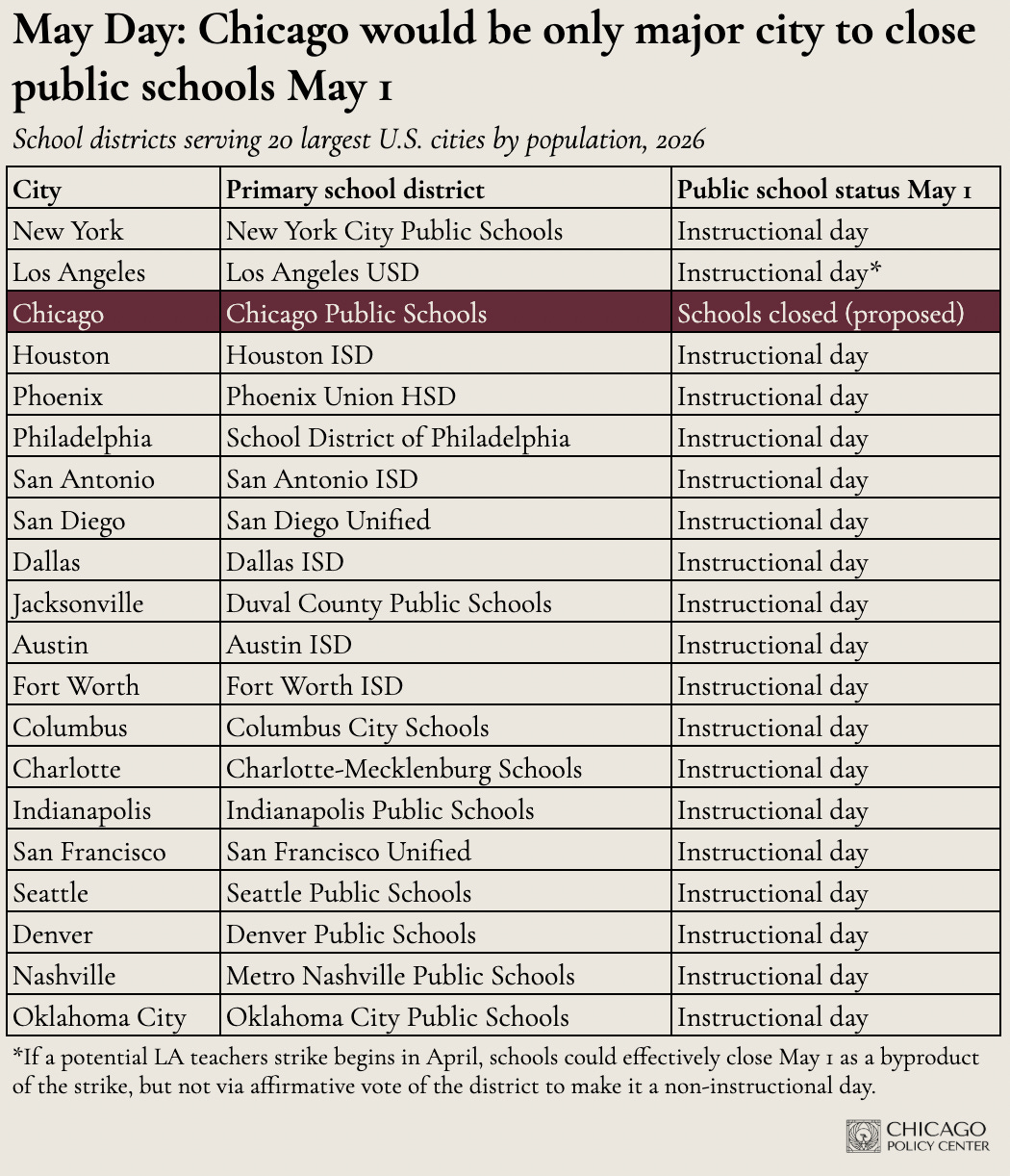
Chicago is an outlier. But why?
What’s happening?
Several key actions led the district up to this point. Here’s a timeline of what you need to know.
The resolution: CTU’s House of Delegates passed a resolution in March declaring May 1 a day of “no school, no work, no shopping.”
The grievance: CTU then filed a grievance April 6, alleging Chicago Public Schools violated their contract by refusing to move a planned, teacher-led professional development day from June 5 to May 1.
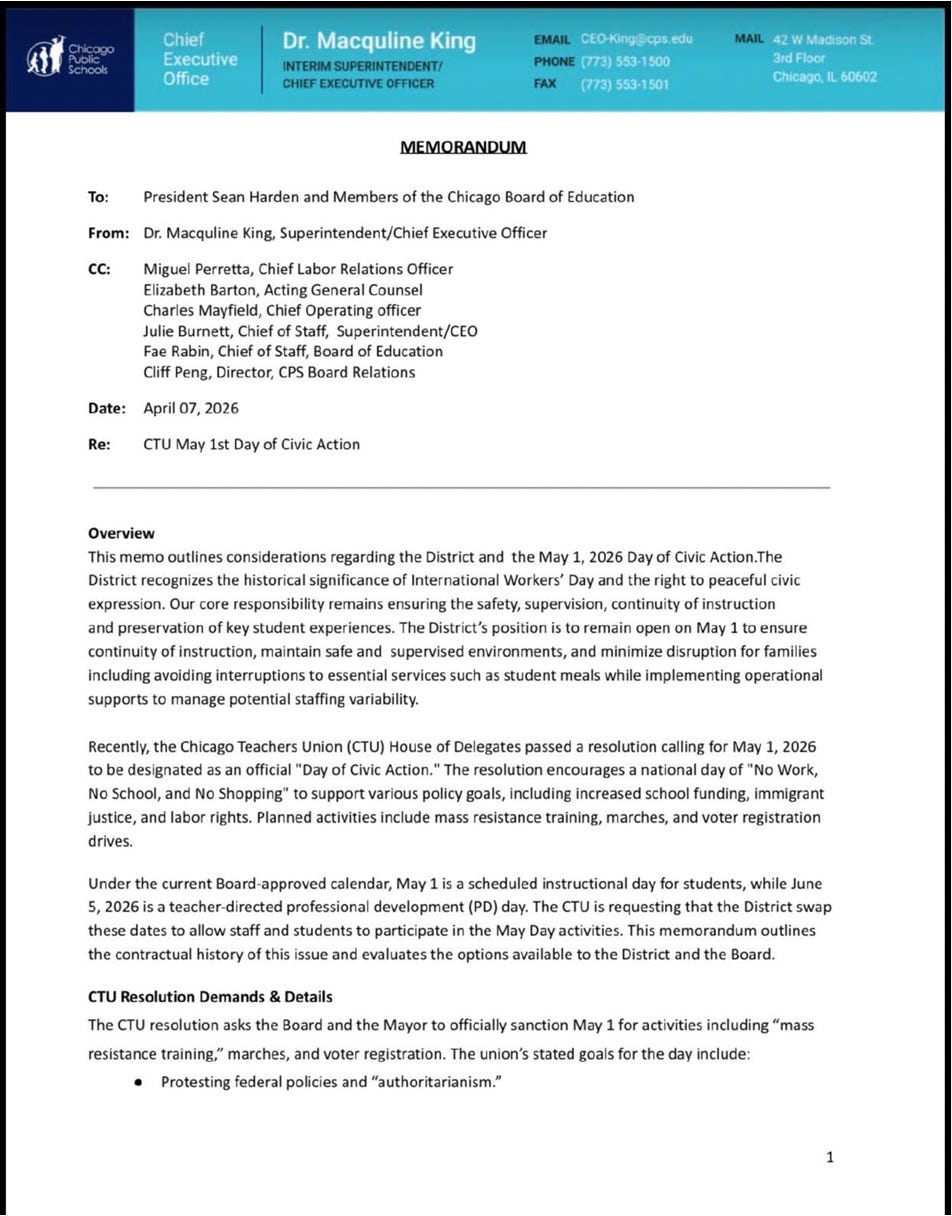
The response: CPS CEO Dr. Macquline King responded to the grievance with a detailed memo to the school board, showing that while CTU’s contract does have a provision allowing for a teacher-led professional development day:
The provision doesn’t take effect until next school year.
The date of that professional development must be agreed upon by the union and the board.
A professional development day is not the same as declaring a district-wide non-attendance day.
A closed-door vote: Chicago Board of Education President Sean Harden sent a brief letter to King on April 9 saying the school board had approved (in closed session) a “day of civic action” on May 1.
King reaffirms position: In response to the confusion caused by Harden, King then sent a letter to CPS staff and families stating that her position is to maintain May 1 as an instructional day. But if the school board wants to change the calendar to make it a non-attendance day, “they may convene a special Board meeting for a formal vote on this matter.”
What’s next? The school board’s next scheduled meeting is April 23, just a week before May Day. But the board could hold a special meeting before then to take a vote, with 48 hours notice to the public.1
Why is this up for debate?
Chicago’s outlier status among other big cities on May Day raises an important question.
Why is shutting down schools for a union-led protest part of a contract discussion in the first place?
In part, it’s because of a state law passed in 2021 that repealed limits on CTU’s collective bargaining powers. There are now virtually no limits on what CTU can demand at the bargaining table, which means unlimited political moves and unlimited grievances.
It’s one of five ways state law gives CTU leadership more power than Chicago parents, students and even elected officials in deciding how schools are run.
What can you do?
Chicagoans who don’t agree with the push to close schools on May 1 should consider the following.
Contact your school board member: Tell your school board member to keep schools open on May 1. You can look up and contact your board member here.
Reject CTU-backed school board candidates in the November elections: While CTU-backed candidates lost a majority of their school board races in 2024, the board is still mostly composed of Johnson appointees backed by the union. But this November, all 20 seats and the president will be up for election.
Tell your state lawmaker to reinstate limits on CTU’s power: Political protest days should not be the subject of collective bargaining. State law should explicitly ban this practice. (CTU’s current contract ensures this same chaos will come up again next year around May Day. And the year after that.) Find your Illinois House and Senate member here.
Watch your public officials: Lawmakers’ response in this moment, or lack thereof, is worth noting. Are they denouncing the push to shut down schools? And if so, are they highlighting the state’s role in enabling it?
In the news
I joined WTTW’s Chicago Tonight to debate whether Illinois should adopt a proposed “millionaire’s tax.” More on that topic in a future edition of The Last Ward.
I also joined the Mincing Rascals on WGN to discuss how to bring professional excellence to the Chicago Police Department, the Iran war ceasefire, the May 1 walkout, and more. (Apple, Spotify, Youtube)
One caveat on the board vote worth mentioning: The Chicago Board of Education does not have home rule power, which means it can only do what state law explicitly authorizes it to do. Under state law, the board can certainly vote to change the school calendar. But does state law allow school boards to facilitate a highly political union takeover of school activity for a day? The details of what exactly CTU plans to do with students on May 1, including how it’s funding those activities, could create significant legal liabilities for both the union and the school board, should they vote to make May 1 a non-attendance day.
Also not discussed, even though CTU is proposing to swap professional development day from June 5 to May 1 for it's members, what would total cost be to CPS (taxpayers) to meet CTU "grievance" for non-CTU staff, etc, etc?
At what point are all the other +850 Illinois school district, especially now that Gates is president of IFT, going to demand the same equal bargaining rights as CTU to collective bargain over anything under the sun especially if CTU is successful with May 1 grievance/ demand? Why did the powers that be in Springfield, when drafting HB2275, only grant CTU the right to bargain over anything by stipulating HB2275 only applies to cities over 500,000 population (Chicago)? Or/and also won't all other unions demand equal treatment? (I think I got my HB correct?).....this is a first of it's kind big deal nationally folks!
How does this fit in with JBs presidential ambitions, he's been pretty quiet on where he stands.