


Chicago Bears Head Coach Ben Johnson went viral last year for his call to greatness.
“Good, better, best. Never let it rest. ‘Til your good gets better. And your better gets best.”
Chicago government has fallen short of that expectation for decades. And the Chicago Police Department is no exception.
Two landmark reports published last week provide a game plan to make the Chicago Police Department the most effective, professional, trustworthy big city police department in the country.1
Here are the five most important takeaways.
1. CPD is a national outlier on civilian staffing. And that’s costing the city real police work.
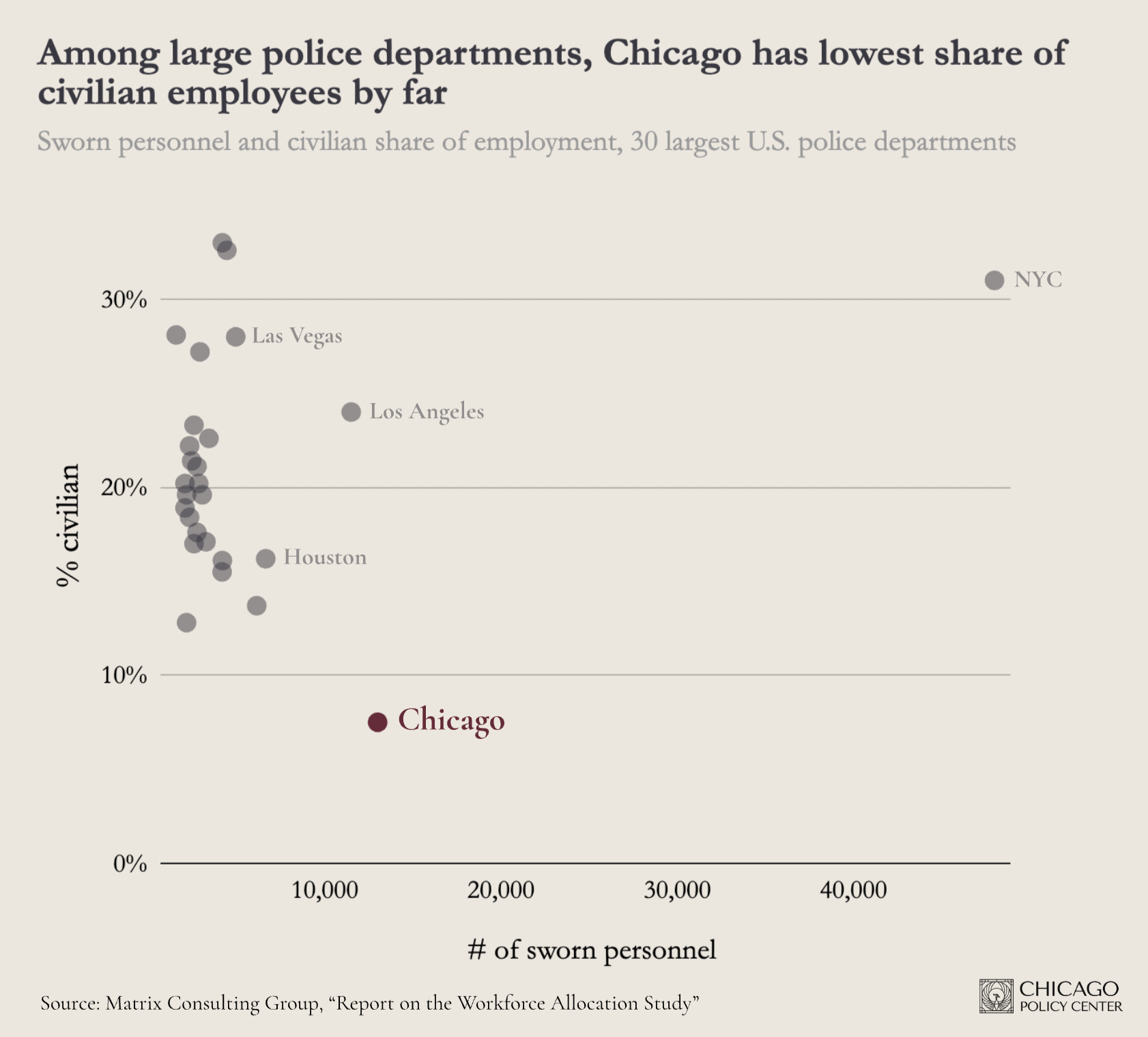
Of the 30 largest police departments in the United States, CPD has the lowest percentage of civilian employees, at less than 8% of its workforce.
For comparison, NYPD is at 31%. LAPD is at 24%.
The workforce allocation study identified 604 sworn police officers — people with badges, guns, and the authority to make arrests — currently assigned to jobs that require none of those things, such as timekeeper (42 officers), watch secretary (98 officers) and police district administrative support staff (85 officers).
These police officers are not on patrol. They’re not building relationships. They’re not responding to calls.
CPD can move these officers into roles where sworn expertise is actually needed, and hire civilian professionals to back-fill the positions at a fraction of the cost.
This misuse of talent is hurting public safety.
2. Some neighborhoods are not proactively policed.
The workforce allocation study also measured “proactive time” — the share of a patrol officer’s shift not consumed by responding to 911 calls, handling backup, and writing reports.
The industry benchmark for proactive time is 40%. Below that level, officers are chasing the radio. Above that level, officers have enough time to build community relationships and engage in problem-solving.
CPD averages 40% proactive time citywide. But that average conceals some shockingly low numbers at the district level.
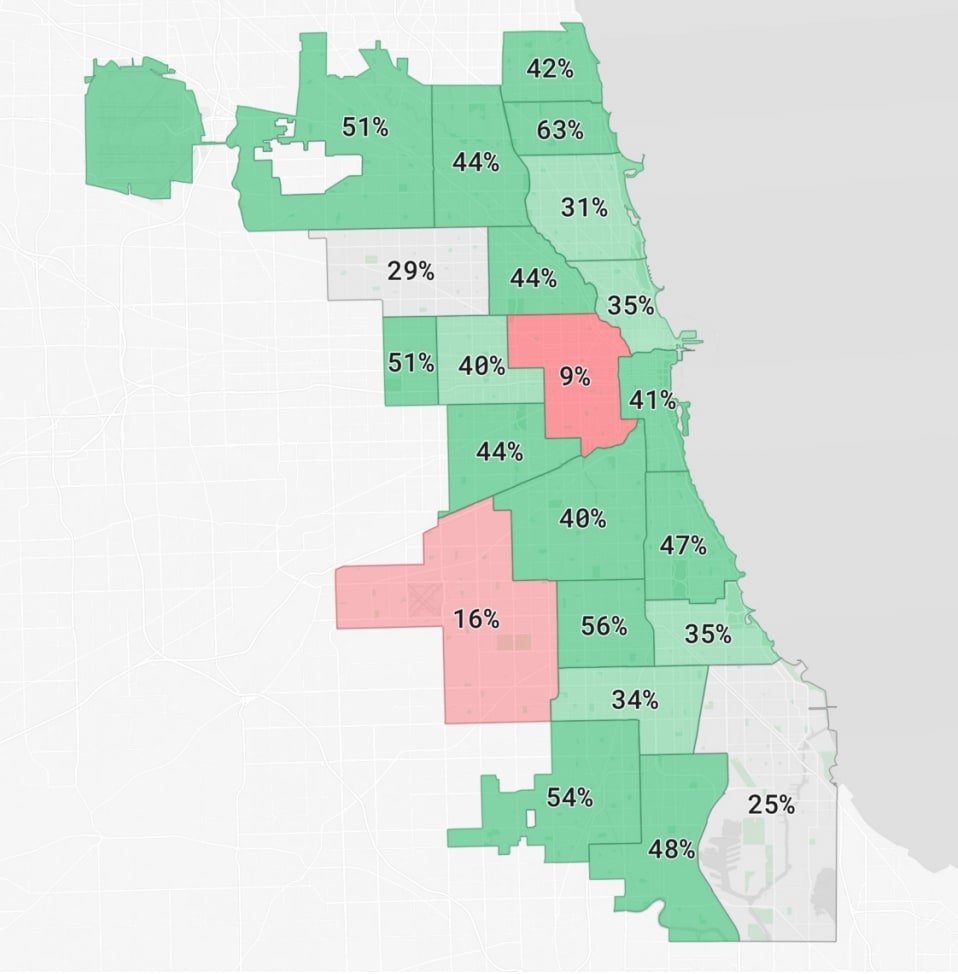
The 12th District, which includes the West Loop neighborhood, ran at just 9% proactive time. The lowest rate in the city.
As the report states bluntly: “When proactive time levels are as low as 9% ... virtually no time is available for proactive work or community engagement, and low-priority calls will frequently go without a response for extended periods of time.”
Fixing this imbalance without reducing current force in any district, according to the study, requires 273 additional patrol officers. And those slots can be filled by taking sworn officers off the jobs civilians could do instead.2
3. CPD is missing basic management fundamentals
The average Portillo’s employee often enjoys better management practices at his workplace than do rank-and-file CPD officers.
The workforce study revealed CPD lacks basic management information about its own operations. For example, the department does not have a unified system for tracking how many officers are redirected to special events, how often, or for how long. In practice, that means no reliable, centralized record of what those officers are doing.
Beyond missing data, the reports identify management practices that any professional organization would treat as standard, and that CPD has never consistently applied. Practices like:
Standardized supervisor-to-officer ratios. Critical for performance evaluations and early intervention when officers show signs of misconduct or underperformance.
Unity of command. Officers working with the same supervisor every day. Mentorship and accountability require stable supervisory relationships.
Geographic integrity. Officers and supervisors working the same neighborhoods consistently is a precondition for community relationships.
Built-in time for community engagement by every officer. This is critical for proactive problem-solving.
None of these are advanced reforms. They are the basic management systems that shape how officers show up in everyday interactions with the public.
4. Poor management is producing poor customer service.
The management failures above have a direct human consequence.
When officers have no beat integrity, they don’t know the communities they serve. When they’re chasing the radio all day, they have no time for meaningful interaction. And when there’s no standard for how to treat people, there’s no accountability when it goes wrong.
Released in tandem with the workforce allocation study was an analysis on community policing practices within CPD. Its core finding was that community policing has failed not because the concept is wrong, but because it was never actually adopted as a philosophy.3 It was adopted as a program. Far too many programs, in fact.
There are currently about 400 specialized community policing roles across nearly 40 distinct titles, running alongside 19 different departmental policies that are, in some cases, contradictory. There are at least 112 separate trainings at CPD that reference community policing concepts. And yet, one officer in a focus group put it this way: “We’ve never been trained. Yet CPD has so many trainings! Our duties are not clearly outlined.”
The practical result is that every officer in the department knows community policing is someone else’s job.
Most surprisingly, the report found CPD has no clear, department-wide framework guiding how officers are expected to engage with the public in everyday interactions.
The result, documented in community focus groups across 21 neighborhoods, is that officers are too often described as unapproachable, unwilling to engage, aggressive, or disrespectful.
The only way to fix this is to stop treating community policing as a specialized function and make it the baseline expectation for every officer in every interaction.
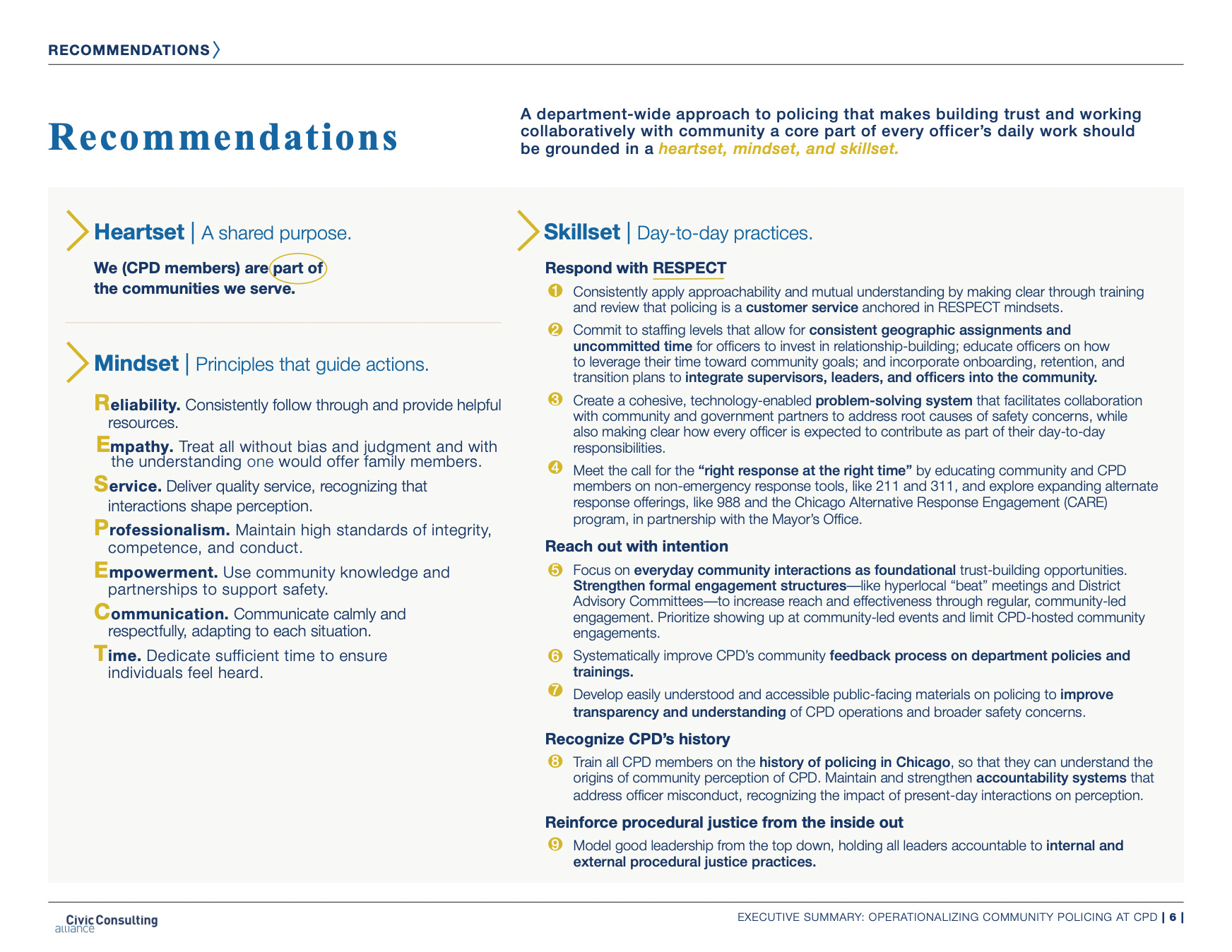
“If we want to build true and lasting partnership in every community, community-focused policing has to guide every member of our department, regardless of their assignment,” Superintendent Larry Snelling said last year.
“We’re committed to making the needed changes to put this into practice, and we must break down existing silos internally to ensure every officer holds the responsibility of building trust with the residents we serve.”
The department has a long way to go.
5. Governance is still a missing ingredient
Read together, these reports chart a path that does not require a fiscal miracle or a generational culture shift to begin.
Stop deploying sworn officers in administrative roles. Rebalance patrol staffing to match workload. Merge redundant community policing programs into a coherent structure. Give every officer clear expectations for community engagement as part of their daily job.
The analysis is done.
But the deepest obstacle is outside the purview of these reports: Chicago’s police governance is structured to be overly political, rather than professional.
The real reason Brandon Johnson fired his public safety leadership

When Garien Gatewood walked into a meeting with top mayoral aides on March 19, he thought he was there to finalize the paperwork putting one of his team members on a performance improvement plan.
Last week The Last Ward reported on the firing of Garien Gatewood, Brandon Johnson’s first deputy mayor of community safety. That story, and many others, show what it looks like when policing is governed by political coalition rather than professional standards.
Chicago currently has eight overlapping bodies with some claim to police accountability. Los Angeles — a city 50% larger than Chicago — manages its police department through one primary civilian body: the LA Police Commission.
As Ed Bachrach and I argued in The New Chicago Way, and as we wrote in the Chicago Sun-Times, that model — combined with a consent decree and serious charter reform — helped bring LAPD from among the most troubled big-city departments in America to one of its most improved.
CPD has the analyses and recommendations it needs. What it lacks is a governance structure that Chicagoans can trust will implement them.
That’s the piece neither report can write for us.
In the news
I joined the Ray Stevens Show on WLS to discuss recent departures from Mayor Brandon Johnson’s office.
My colleagues Micky Horstman and Mailee Smith published an analysis of the Chicago Teachers Union’s track record in the Illinois primary elections for the Chicago Tribune. More on that here.
Together these reports represent the most thorough examination of how the Chicago Police Department is organized, staffed, and governed since the analysis undertaken by the Police Accountability Task Force and the Department of Justice leading up to the 2019 consent decree. The first is a 770-page workforce allocation study by Matrix Consulting Group. It analyzes units and functions across the department, drawing on 911 call data, ride-alongs in districts across the city, and extensive interviews with officers and leadership at every level. The second is a 167-page assessment of community policing at CPD, produced by the nonpartisan Civic Consulting Alliance over two years in partnership with the department. It includes engagement with more than 1,100 community members across 45 sessions in 21 neighborhoods, 150 CPD members across ranks and bureaus, 120 representatives from advisory and oversight bodies, and research into 17 major police departments nationwide.
The report notes that many workforce changes are subject to collective bargaining agreements. Springfield grants enormously skewed powers to government unions in Illinois. And that power is often at odds with the best interests of those who rely on government services. This applies to the Fraternal Order of Police just as much as it applies to the Chicago Teachers Union.
Community policing is a proactive strategy focusing on building partnerships between police and residents to collaboratively solve problems and reduce crime.