

As Chicagoans gather for the holidays, here’s a party trick to make the whole room groan like the hull of a wooden ship.
All you have to do is say two words.
“Parking meters.”
On Dec. 4, 2008, in the span of about 72 hours, Chicago handed 36,000 parking meters to private investors for 75 years in exchange for $1.15 billion in cash up front. Seventeen years later, the meters have generated $2 billion for the investors, with 58 years still left on the lease.
Parking rates spiked. Neighborhood business districts lost what had once been a flexible tool of local policy. And City Hall lost control of its own curbs. Adding insult to injury, a significant share of the equity in the Morgan Stanley-led deal traces back to the sovereign wealth fund of the United Arab Emirates—meaning a portion of every dollar Chicagoans feed into a meter ultimately flows to a foreign government.
The parking meter deal is the most infamous political tale in modern Chicago history. It dominates how normal people think about City Hall. It is maybe the one thing Chicagoans of all political stripes agree on: they hate it.
Yet, despite all the attention, Chicago learned the wrong lessons from the parking meter deal. And because of that, the city is still repeating the same mistakes.
What actually happened that week
Here’s the basic timeline of the deal:
Dec. 2–3, 2008: Chicago Mayor Richard M. Daley’s team unveils a proposed 75-year lease of the city’s metered parking system to Chicago Parking Meters, LLC, for $1.15 billion.
Dec. 4, 2008: The City Council votes 40–5 to approve the deal after only a few days with a 500-plus-page agreement.
Within two years: The city blows through almost the entire windfall to plug budget holes, instead of locking it away in a dedicated fund.
June 2, 2009: Inspector General David Hoffman’s office finds the city was paid, conservatively, $974 million less for the deal than it would have received from 75 years of parking-meter revenue had it retained the system under the same terms that the city agreed to in the lease.
Here’s the whole saga in one sentence: Chicago sold a long-term, flexible revenue source to solve a short-term cash problem, at a discount, under rushed conditions, for an absurdly long term.1
Chicagoans threw up their arms in disgust.
But disgust at what, exactly?
The wrong lessons
1. “The problem was corruption.”
For a lot of Chicagoans, the parking meter deal is proof that Chicago is uniquely corrupt—that this could only happen here. And it’s true: “corruption” played a role.2 Private interests clearly took advantage of an open net. But explaining the deal only with “Chicago is corrupt” misses the more important point: Our system is structurally unsound in a way that gives ordinary corrupting influences extraordinary power.
Every big city has lobbyists, bankers, law firms, and sovereign wealth funds eager to gobble up public assets. What made Chicago such an easy mark wasn’t that our people are uniquely evil. It’s that our operating system is unusually flimsy. And if you focus only on crooks, the solution is then simply to elect nicer people, and hope for the best.
2. “The problem was Daley.”
Daley deserves a huge share of the blame. But if this becomes just a Daley morality play, the city tells itself a comforting story: The machine did this. And since the Daley machine is gone, we’re safe. The truth is uglier: Daley used the system as designed. One office, the mayor, was negotiating the deal. One office, the mayor, was directly presiding over the legislators voting on the deal. One office, the mayor, held the keys to the information and staff time necessary for City Council to vet the deal. That system still exists today.
3. “The problem was privatization.”
A third lesson many people took is that privatization itself is always a scam. But that’s also too easy. There are services that can be sensibly contracted out. There’s a real debate to be had about fully privatizing Midway Airport, for example. But the problem is doing large-scale privatization inside a broken structure. Chicago is like a factory that keeps bolting on experimental machinery without having working safety systems. City government should not be running high-risk maneuvers with our most precious public assets with no basic guardrails in place.
The right lessons
The clearest way to see what actually went wrong with Chicago’s system is to ask: What if another big city tried this?
The most helpful example in New York City, where long-term use of public assets is governed by the city’s charter. Here’s how a Chicago-style parking meter deal would have gone down:
A citywide on-street parking concession would trigger review and approval by the Franchise and Concession Review Committee, or FCRC, which includes the mayor, the budget director, the city’s top lawyer, the independently elected comptroller, a mayoral appointee, and a representative of the borough presidents.
Under New York’s charter and implementing rules, these deals are time-limited. Franchises generally can’t exceed 25 years under the charter, and the FCRC’s rules cap concessions at 20 years (including extensions) unless the committee unanimously finds “extraordinary circumstances” to go longer.
To pass Chicago’s 75-year lease, New York would have to amend its charter to relax those limits. And under §38 of the New York City Charter, any local law that changes provisions relating to public utility franchises or removes charter restrictions on the sale or lease of city property must be submitted to the voters for approval.
In short, a Chicago-style parking meter deal would be theoretically possible in New York City. But it would be a political moonshot, because the city charter forces these deals into daylight, with more actors involved and stricter limits. And in some cases, that means getting approval directly from voters.
But Chicago does not have a city charter. The process for deals like this is governed by which political figure can count up to 26 votes in the council. That’s it.
Chicago didn’t fix the problem
After the outrage, Chicago “did something” by passing the 2015 Privatization Transparency, Accountability, and Performance Ordinance.
Drafted explicitly in response to the parking meter debacle, it requires independent financial analysis from outside advisors, public posting of deal terms, and minimum waiting periods between when a deal is introduced and when the City Council can vote.
It’s better than nothing. But it has a fatal flaw: it is an ordinary ordinance that can be erased or weakened with a simple majority vote. Chicago created a bit more process. But the city did not create real constraints.
Proof we haven’t learned
If the parking meter mess had truly changed how Chicago behaves, the city would treat it as a turning point. Instead, leaders found new ways to sell off the future.
Earlier this year, the City Council approved an $830 million general obligation bond package backed by Mayor Brandon Johnson. The headline was infrastructure spending. The real story was the structure of the debt:
The total repayment cost is projected to be roughly $2 billion, to borrow $830 million
For the first two years, the city makes no payments at all. Nothing in FY2025 or FY2026.
The city makes interest-only payments through 2043—meaning taxpayers make no dent in the principal for 18 years, long after the current administration and most current aldermen have left office.
In most other big cities, this borrowing plan would have been subject to independent analysis from a controller, a robust City Council, and ultimately voters.
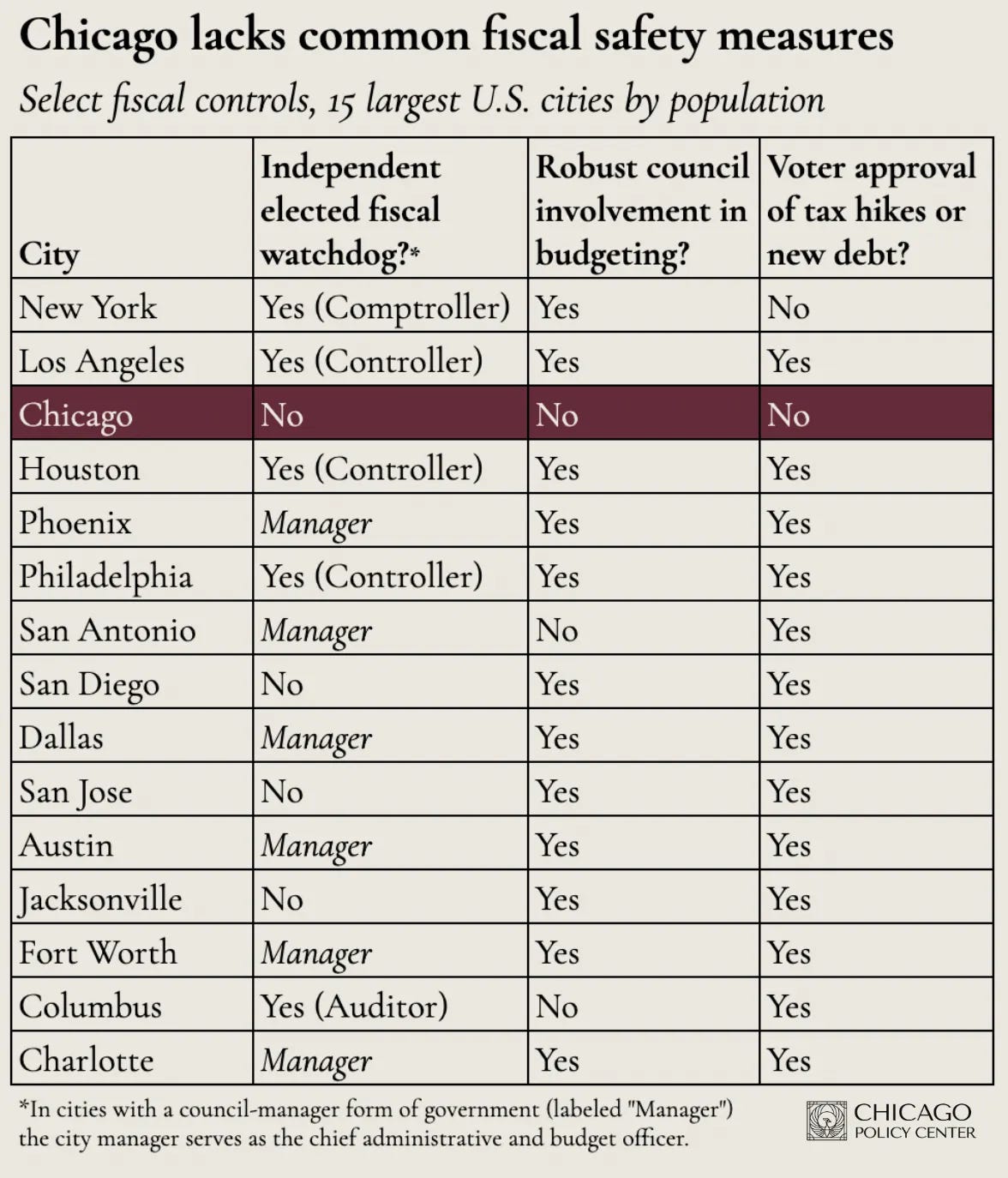
But Chicago has none of these controls, much less a charter that can protect them from political whims.
What Chicagoans should actually hate
Jeff Tweedy once remarked that his favorite lyric he’s ever written was “Hate will save the dolphins.”
A sad reality of politics is that hatred is often more powerful than love. It unifies people who might agree on little else.
Chicagoans are right to hate the parking meter deal. The trick is to hate it for the right reasons. And to harness that energy to build a governance structure where a 75-year heist in 72 hours cannot happen again.
For a play-by-play of how Daley’s team kept aldermen and the public in the dark, start with Ben Joravsky and Mick Dumke’s investigative work at the Chicago Reader. Their FAIL series remains the definitive account of the parking meter deal and should be required reading for Chicago high-schoolers.
“Corruption” here refers to legal corruption: the use of power, influence, and access in ways that are ethically dubious but technically compliant with the law.