

Chicago Mayor Brandon Johnson has launched his re-election campaign. But he’s in serious danger of being removed from the ballot.
He’d be the only incumbent Chicago mayor in history to meet this fate.
Candidates for mayor of Chicago need 12,500 valid signatures to appear on the ballot. Johnson filed just under 32,000 signatures. But the more of those signatures the Chicago Board of Election Commissioners reviews, the worse it looks for the mayor.
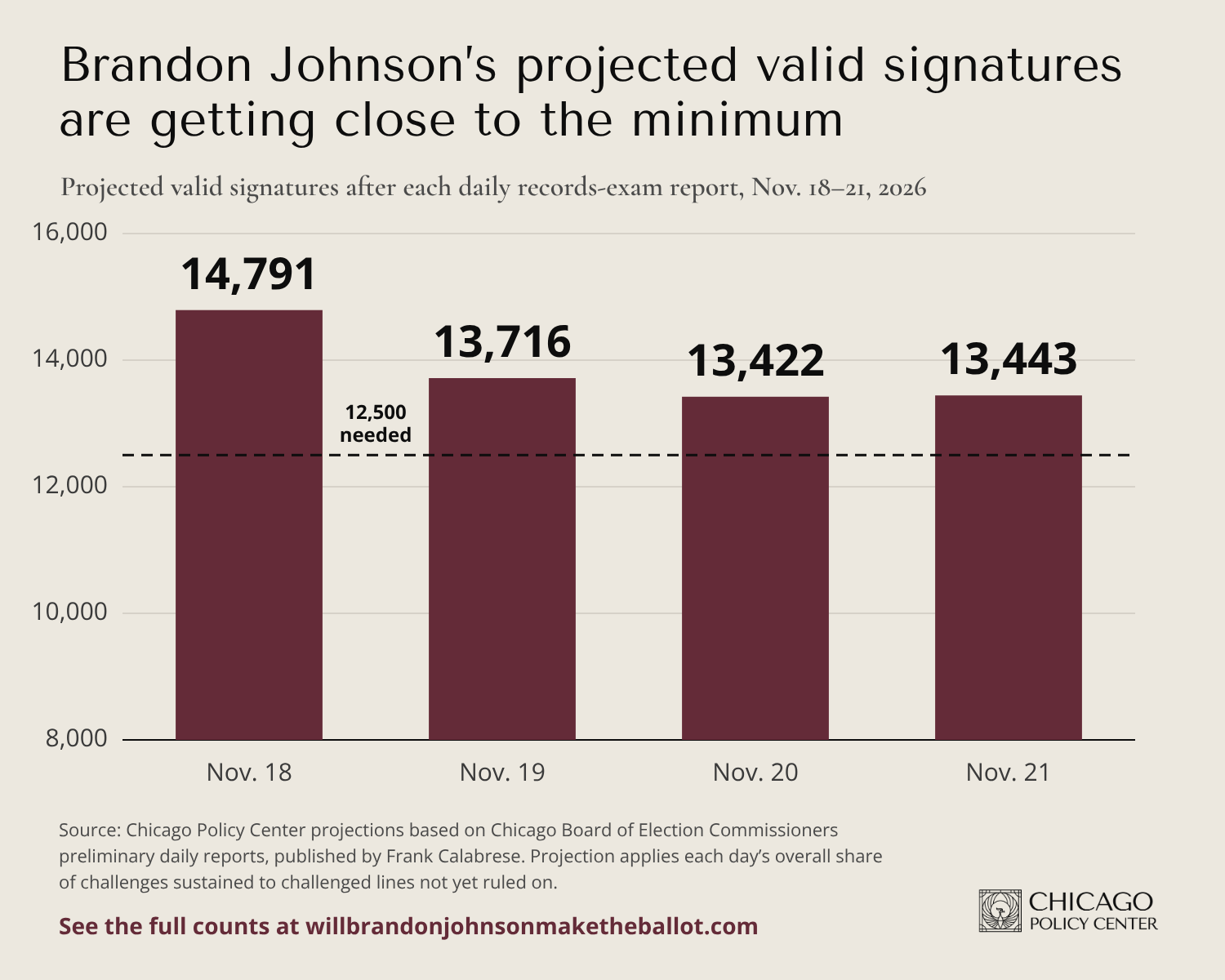
To check the latest daily counts and make your own projections, explore the Chicago Policy Center’s newly launched live tracker at willbrandonjohnsonmaketheballot.com. Here’s how the latest numbers break down.
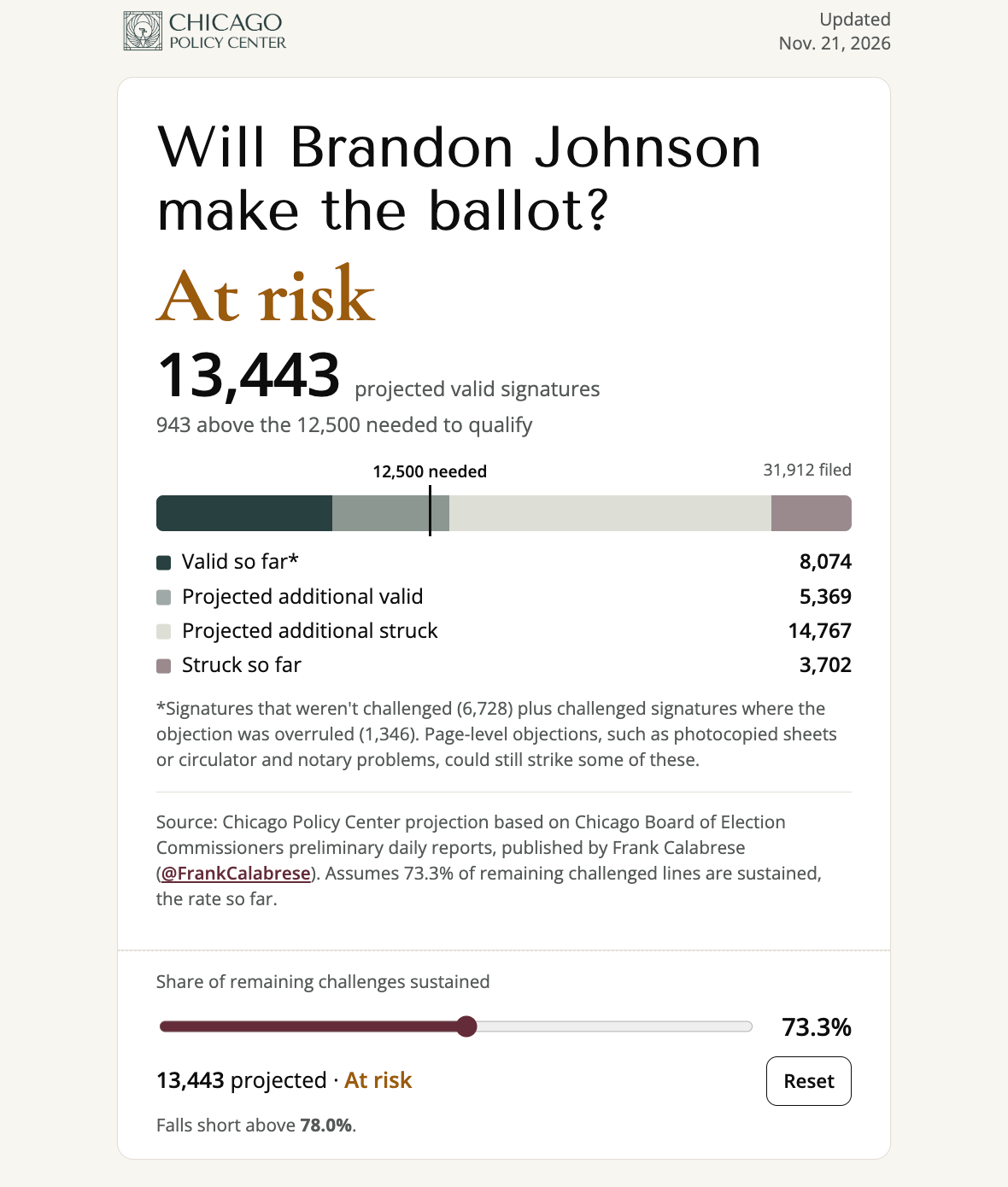
Johnson deserves the heat he’s taking for botching the most basic job of a campaign for mayor.
But this drama also exposes the absurd system that every Chicago mayoral candidate has to survive. This system wastes public resources on a byzantine paper process. It encourages fraud. And it can be fixed.
How a Chicago mayor gets on the ballot
Candidates for mayor of Chicago must turn in 12,500 valid signatures from registered Chicago voters, collected within a 90-day window.1 No other big city runs its mayoral elections like this.
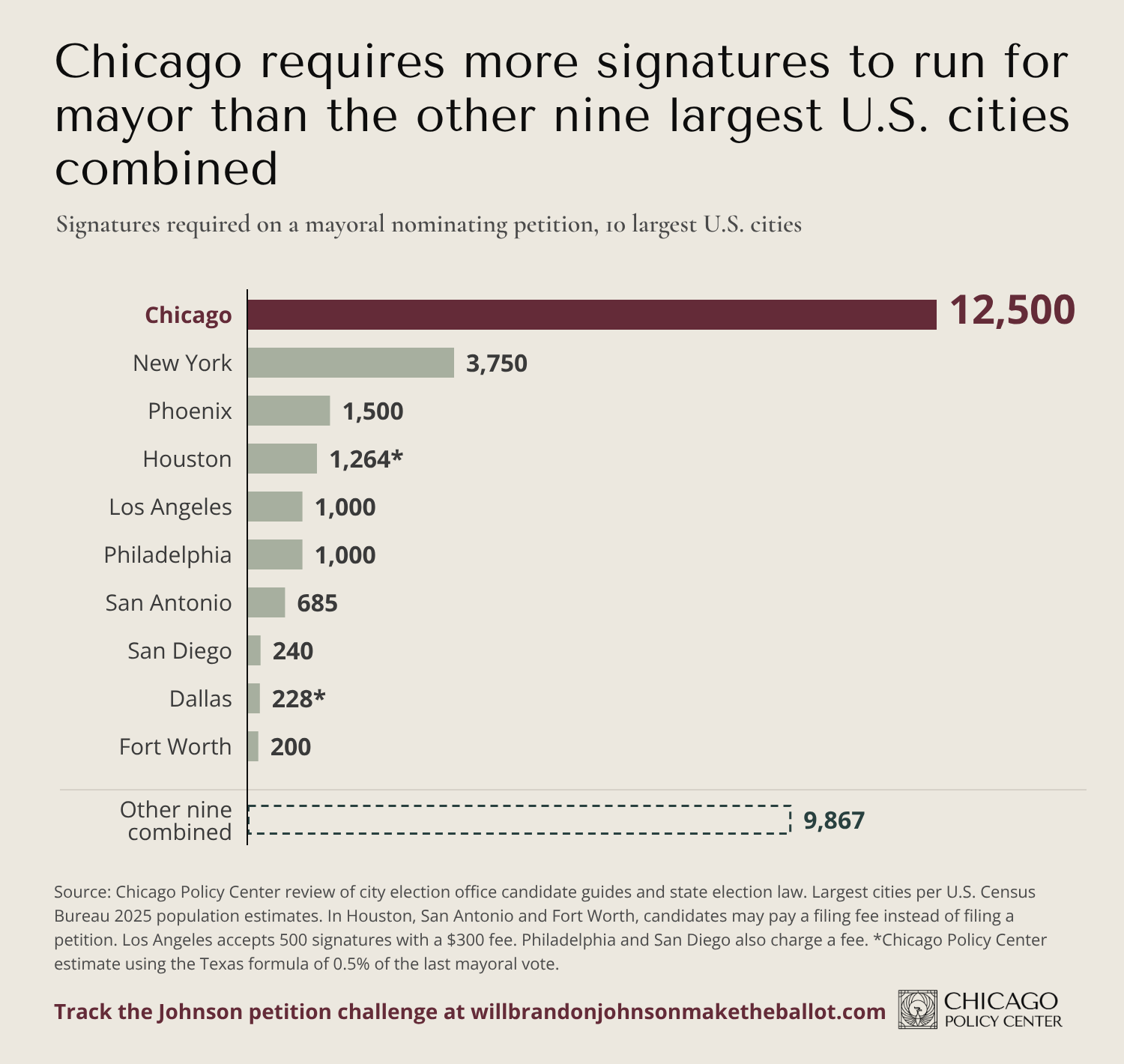
Chicago requires more signatures to run for mayor than the other nine largest U.S. cities combined. New York has three times Chicago’s population and requires 3,750 signatures.
The comparison inside Illinois is also lopsided. A major-party candidate for governor needs just 5,000 signatures to get on the ballot.
So how did Chicago land on 12,500?
Why is Chicago’s signature requirement such an outlier?
Most big cities write their own ballot rules. But not Chicago.
Seven of the nine largest cities outside Chicago have some piece of their mayoral ballot access rules within their city charter. Four of those cities’ charters actually contain the numerical signature requirement: New York, Los Angeles, Phoenix and Fort Worth.
Chicago has no city charter. The mayoral petition signature requirement rests in state law. And that law has an interesting history.
Here’s a brief timeline:
1931-1979: Independent candidates for mayor of Chicago needed signatures equal to 5% of the last vote for city office. In the 1977 special election after Richard J. Daley’s death, that meant independent candidates needed a whopping 35,947 signatures: a near-impossible task without a patronage army.
1979: The Socialist Workers Party and other minor-party and independent candidates sue over the signature requirement rules. Writing for the U.S. Supreme Court in Illinois State Board of Elections v. Socialist Workers Party, Justice Thurgood Marshall holds that no independent or new-party candidate for mayor can be asked for more than 25,000 signatures, the same number it takes to run as an independent candidate for governor.
Through 1995: Chicago mayoral races are partisan. A Democrat needs about 3,000 signatures to make the primary ballot. A Republican needs about 1,000. (The signature requirements are tied to a share of the party’s primary voters.)
1995: Republicans, who control the General Assembly, pass a law making Chicago’s elections nonpartisan with a runoff, starting in 1999. Gov. Jim Edgar signs it. The law does not list a signature number. Instead, it tells candidates to follow the rules for independents. So every candidate for mayor now needs 25,000 signatures.2
2005: State lawmakers cut the signature requirement in half, to 12,500, after South Side activist Bruce Crosby and others pushed for reform.
2014: A federal appeals court upholds the 12,500 requirement in Stone v. Board of Election Commissioners.
More recently, bills to lower the signature threshold in Chicago to as few as 2,500 have died in Springfield.
How to improve Chicago’s petition-gathering process
Chicago voters, not lawyers, should decide who gets on the ballot.
The best fix is a voter-approved city charter that lets Chicago set its own ballot access rules, the way New York and Los Angeles do. But Chicagoans don’t need to wait for a charter to improve the current system.
In 2015, Denver launched eSign, a tablet app that checks each signer against the voter rolls before they sign. Paper petitions in Denver historically ran 30% to 40% invalid. With eSign, Pew found just 2.7% were rejected. Every candidate who used it qualified on the first try. Johnson, by comparison, is on pace to lose nearly 6 in 10 of the signatures he filed.
Former Cook County Clerk David Orr pushed for this fix. When he left office in 2018, Orr ranked ballot access first on his list of needed election reforms and proposed piloting eSign in Cook County. “The Denver Elections product, called eSign, is ready for Cook County,” he said.
Washington, D.C., has used eSign since 2018. State Rep. Kelly Cassidy, D-Chicago, has twice filed bills to let Chicago offer the same option. Neither passed.
If Springfield won’t give candidates the option of using something like eSign, it should at least cut the signature requirement to match peer cities.
To be clear: There’s no excuse for Johnson failing to collect the requisite signatures. The rules are the rules, and plenty of other mayoral candidates have followed them. But Chicago makes it harder to get on the ballot than any other big city in America.
And for what benefit? A process that routinely tosses out half the signatures filed by legitimate candidates tells voters little about who has support. It mostly rewards campaigns that can afford paid circulators and election lawyers.
It also invites fraud. Election attorney Michael Del Galdo calls forging signatures “one of the most common illegal tactics” in petition drives. Many of the city’s documented cases trace back to paid circulators, including “round-tabling,” where workers sit around a table copying names from voter lists onto petition sheets. And a forged signature rarely gets caught unless an opponent pays to challenge it.
Taxpayers pick up the tab for rooting out fraud and errors: In 2023, the election board spent about $258,000 on handwriting experts, court reporters and hearing officers.
Yet plenty of Chicago political veterans defend the ordeal. Psychologists have a name for this: effort justification. In a 1959 experiment, Elliot Aronson and Judson Mills found people who sat through an embarrassing initiation to join a discussion group rated the group more highly than people who got in easily.
It’s the logic of fraternity hazing. Many who survive it want the next pledge to suffer, too.
Chicago’s politicians survived the hazing.
Voters shouldn’t have to.
The fine print is unforgiving. Each signer must be registered at the address written next to their name. A voter can sign for only one mayoral candidate. The sheets must be fastened together and numbered in order. Every sheet needs a circulator’s statement sworn before a notary, and one bad notary stamp can wipe out a page of good signatures. Signers who print their names instead of signing can be struck. And if a circulator turns out to be ineligible, every signature that person collected is thrown out.
Was this an accident? It’s hard to say. Ballot-access expert Richard Winger called the law “carelessly drafted.” But the 25,000 bar suited anyone with a patronage army. Richard M. Daley’s ward organizations once filed more than 100,000 signatures for him, and he had no objection to the bill.
I hope he does!
eSign and its effectiveness in Colorado are news to me. Thanks for the info. I prefer a change in the rules afforded by a city charter, but eSign would do in the meantime.