

For the first time in 30 years, Chicagoans will vote on a fully elected school board in November.
But who will be on the ballot? Well, that’s a legal matter. Under dispute.
Because in Chicago, securing your name on the ballot can often prove more difficult than winning at the ballot box.
Every election season, lawyers trained in the dark arts of signature challenges spend weeks in the basement of the Chicago Board of Elections, working to kick candidates off the ballot.
This installment of The Last Ward examines the drama surrounding candidates for school board, a legislative plot to rewrite petition signature requirements, the ruthless nature of signature collection, and how one city successfully dismantled byzantine ballot challenges and the rampant fraud that comes with it.
Why more than half of Chicago school board candidates are facing petition challenges
Chicago school board candidates have been passing petitions for months to get on the ballot.
State law sets the rules for gathering those signatures, which candidates had to file with election authorities by May 26.
But on May 30, a curious piece of legislation appeared in the waning hours of Springfield’s legislative session: An amendment to an elections omnibus package, the bill would have retroactively changed the rules about who was eligible to circulate petitions on behalf of Chicago school board candidates.
The package did not pass. But the Chicago Teachers Union lobbied for that amendment, according to Statehouse sources, suggesting that the union had problems with the signatures they gathered for their preferred school board candidates.
Indeed, 28 of the 51 school board candidates are now facing petition challenges, including many of the candidates supported by the union.
Notably, CTU did not file challenges against any candidates. The union even claimed it was unfair to do so. President Stacy Davis Gates said she “wanted to see more people on the ballot, not less.” But that rings hollow, given the union used petition challenges to kick 12 school board candidates off the ballot in 2024, according to Chalkbeat Chicago.1 In fact, the union hired the same election attorney their opponents are using today: Michael Kasper.
The CTU’s push to change the rules retroactively—helping the union’s political machine while hurting those who followed the law—was unfair and undemocratic.
But state lawmakers should change the rules going forward. Here’s why.
The nightmare of signature gathering in Chicago
A Chicago voter seeking to kick a candidate off the ballot files an objection to that candidate’s petition signatures with the Chicago Board of Elections.
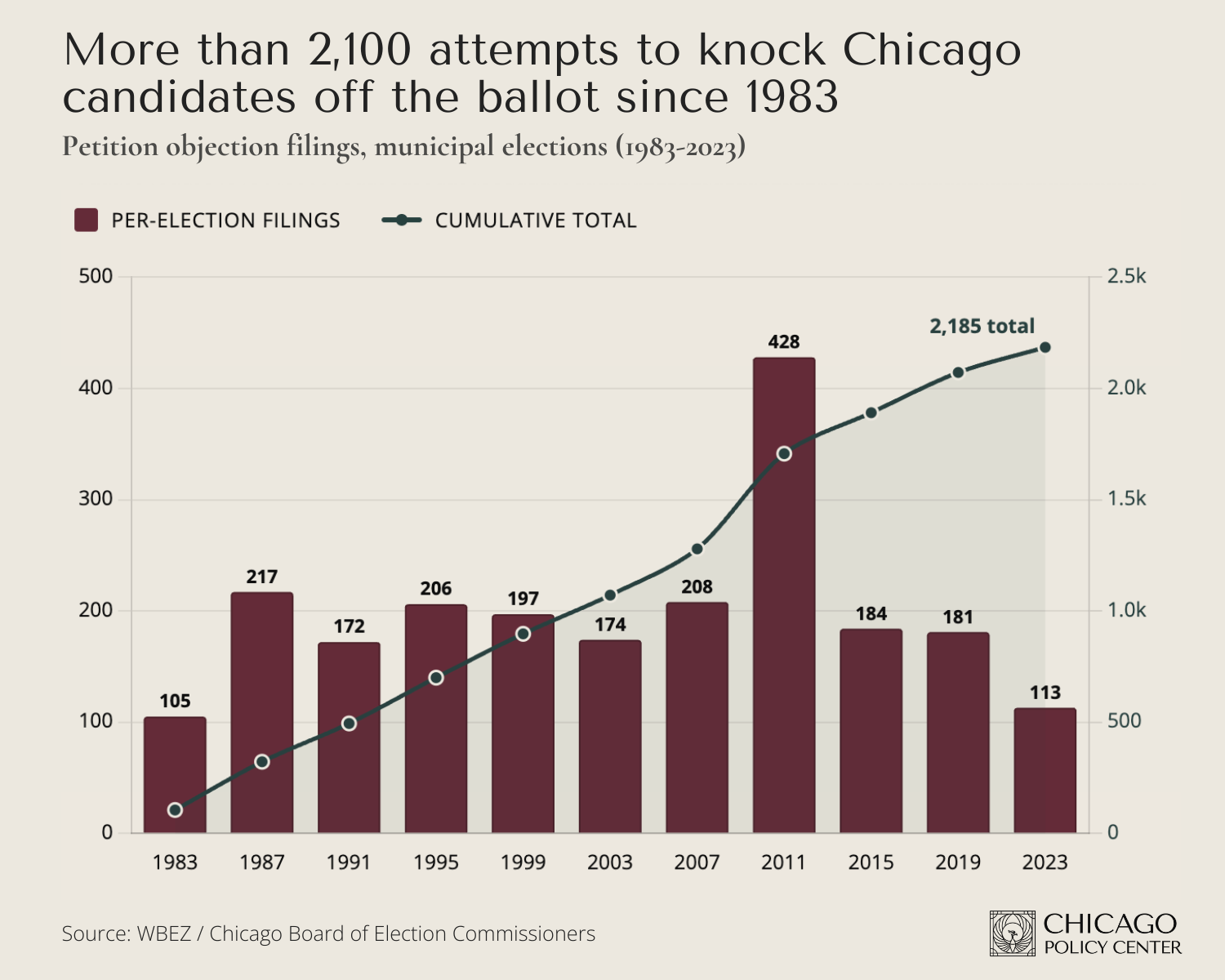
There have been more than 2,100 of these filings in Chicago’s municipal elections alone since 1983, according to WBEZ analysis.
Some of the specifics are absurd:
An average Chicago municipal election sees more than 180 objection filings.
In 2011, there were more objections filed (428) than candidates (380).
In 2015, half of candidates who filed faced objections and one-third were removed from the ballot
In 2019, nearly half of candidates faced objections, and one-fifth were removed.
Each filing typically comes with several hearings in front of a hearing officer, often taking weeks. The officer then makes a recommendation to the election commissioners on whether the candidate has enough signatures to remain on the ballot.
Petition signatures can be ruled invalid for a number of reasons, here are just a few:
The petition pages weren’t properly bound together
The petition pages weren’t numbered
The signer printed their name rather than writing it in cursive
The signer wrote their address incorrectly
The signer already signed another candidate’s petition
The volunteer or paid staffer gathering those petitions was ineligible to do so, making all the signatures they gathered invalid
The petition circulator did not properly sign their name on the petition page, making that entire page of signatures invalid
No media better describes the dark underbelly of the petition challenge process than City So Real. Director Steve James’ five-part documentary miniseries explores Chicago through the lens of the 2019 mayoral election, and follows candidates into the basement of the Board of Elections.
“I had no idea just how Byzantine and ruthless it could be,” James said.
“Chicagoans, particularly of the political class, love to brag about how tough Chicago is politically. I don’t know that that’s something we should be bragging about… Politics is a tough game no matter where you are, but what makes it tough in Chicago doesn’t necessarily make for great leadership and great governance, because what often comes with that is backstabbing and gamesmanship and corruption.”
Here’s the good news: This is an easy fix.
A better way to get signatures
Chicagoans are familiar with political operatives flagging down pedestrians with clipboards and paper.
But for the last decade in Denver, candidates for office can collect digital signatures on an iPad with an app called eSign. That app automatically checks whether the person entered the correct information and is eligible to sign, and then securely uploads those signatures directly to the election authority.
The results are stunning.
In Chicago, roughly half of signatures are ruled valid after adjudication. And in Denver’s old paper system, that rate was about 70%. Today under eSign, 97% of signatures are valid.
This change has severely reduced the cottage industry of election attorneys. It’s also cut down on fraud—a common problem among campaigns using paid petition circulators.
“Forging voter signatures on candidate nominating petitions for elected office remains, unfortunately, one of the most common illegal tactics of unscrupulous campaigns or individual petition passers,” according to Chicago-area election attorney Michael Del Galdo.
If a candidate files fraudulent signatures—knowingly or unknowingly—it is unlikely those will be caught without a challenge.
Denver’s system virtually eliminates that problem.
Changing state law
In his 2018 exit interview, Cook County Clerk David Orr put ballot access at the top of his list for needed reforms.
“The Denver Elections product, called eSign, is ready for Cook County,” he told WTTW. “Like Election Day Registration, this can be piloted in Cook County so we can refine it for all of Illinois.”
State Rep. Kelly Cassidy, D-Chicago, filed House Bill 4966 in 2022. The bill would have allowed local election authorities to copy Denver’s example.
It didn’t pass. But lawmakers should revive the effort.
Pass fair rules. Stop the petition scammers. And get more Chicagoans on the ballot in local elections.
In the news
Last week’s edition of The Last Ward examined what Chicago could learn from Washington, D.C.’s response to “teen takeovers.” I joined WGN Radio to discuss those findings (Apple Podcasts, Spotify). Chicago mayoral candidate Susana Mendoza also cited D.C.’s example.
In other news, The Last Ward was first to report Chicago Teachers Union leadership had lost a vote to hike member dues by $8.5 million. We now know the final results of that election: 63% of members voted no, representing a 26-point loss for union leadership.
One school board candidate kicked off the ballot via CTU challenge in 2024, Jesus Ayala, called foul.