

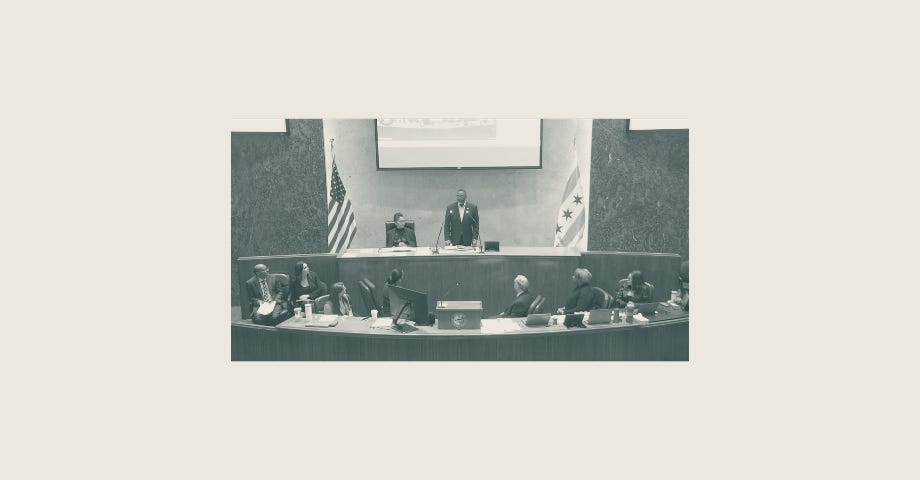
Chicago City Council made history this week by passing an “alternative” budget—something it arguably has never done before.
On its face, that’s a good thing. The Council showed rare independence by rejecting Mayor Brandon Johnson’s proposed head tax and forcing changes to a record $16.6 billion spending plan.1
But independence alone does not equal responsibility.
The reason this budget still fails is the same reason Chicago keeps repeating the same fiscal mistakes: City Council lacks the institutional capacity to govern, the mayor retains nearly all the power needed to shape outcomes, and voters have no formal role in approving major financial decisions.
It’s why the process seemed adversarial, but ultimately produced a budget that was, in substance, almost identical to the one it was supposed to replace.
That contradiction defines Chicago budgeting—and explains why this moment, while encouraging, is still deeply insufficient.
Budget games
Chicago’s budget process echoes Drew Carey’s description of Whose Line Is It Anyway?
It’s a show where everything is made up and the points don’t matter.
The mayor controls an army of analysts, legal staff, and oftentimes, access to basic financial information. City Council, by contrast, relies on the City Council Office of Financial Analysis—an office of four people—to evaluate a $16.6 billion budget.
That imbalance explains why, even this year, the Council’s “alternate” budget remains roughly 98% identical to the mayor’s original proposal. While the new budget is different in that it makes a larger pension payment and axes the head tax, there are some concerning similarities with Johnson’s.
Here are three lowlights they share in common:
A record one-time TIF sweep of over $1 billion, which gives Chicago Public Schools a property tax windfall of $550 million. This functions as a property tax hike that avoids the voter participation required under the state’s tax-cap framework.
Excessive, back-loaded borrowing in part to fund operating expenses, including Chicago Fire Department back pay from a new contract the city knew it could not fund without debt.
No skin in the game from government employees. No pay cuts. No pay freezes. No furlough days. And no reforms to pay more for extremely generous healthcare benefits, as recommended in a recent EY report on efficiencies.2
These three factors combined could trigger another credit downgrade for Chicago.
Ald. Anthony Beale put it in a nutshell with his speech on the Council floor Saturday, before voting in favor of the alternative budget. While acknowledging that what the Council accomplished with extremely limited resources was impressive, which is true, he also showed how the mayor’s office still holds all the cards, forcing poor decision-making:
Last year, we sat in this very seat and we said over and over again to the budget director, ‘Is the money for the fire contract in the budget? Oh yes, it’s in the budget. We’ve set that money aside. That money’s in the budget.’ Now we found out that the money was spent and now we’re borrowing to pay for the fire contract…Did they come to us and say, ‘Aldermen we have a financial problem. We need to spend the fire money that we set aside’? No they didn’t. They spent it, and then came back and lied to us on why they had to spend it. So who are we going to put faith in?
There was a potential silver lining to this budget fight as part of the “management ordinance,” which is one element of the overall budget package. Council members originally considered adding provisions to give themselves more permanent infrastructure for fiscal oversight and analysis, akin to an independent budget office. There was also a provision requiring automatic Council hearings should the Chicago Police Department exceed its overtime budget (a perennial problem). But those items were unfortuately dropped from the management ordinance.
It is a good thing that Chicago does not have a rubber-stamp City Council right now.
But without the proper resources and safeguards, that independent Council will make poor decisions, or simply return to being a rubber stamp under a new administration.
On the other hand, if officials can learn from this experience, it could prove to be truly transformational.
Fait accompli
When given the choice of angering labor or borrowing money without going to voters, Chicago politicians will borrow money without going to voters.
That’s why Chicago has the worst debt problem of any major city in the country, which JPMorgan market strategist Michael Cembalest discussed in a popular recent episode of the Illinois Policy Podcast.
The three lowlights listed above just wouldn’t be viable in many other big cities.
For one, of the 15 largest cities in the country, 13 require some form of voter approval before issuing general obligation bonds. Only New York and Chicago do not. And New York City enjoys a suite of other fiscal safety measures Chicago lacks, including an independently elected comptroller with substantial power, GAAP accounting rules, and an Independent Budget Office.
In other cities, these basic fiscal accountability measures live in a city charter that can’t be changed with a simple majority vote. But Chicago is the only major city that has no charter. Illinois state lawmakers should give Chicago’s leaders and voters the power to create one.
Given the concerning case study presented by the budget process this year, I predict an unprecedented legislative focus on city charter reform in 2026.
In the news
The Washington Post cited The Last Ward in their editorial (“Chicago has lost its mind”) last week:
As Austin Berg of the Illinois Policy Institute said, when the firefighters ran out of cash, the city got a taste of what insolvency looks like. Unless politicians get serious, actually cut spending and start enacting sane, pro-growth policies, Chicago will get more than a taste of that bitter pill.
Illinois State Rep. Maurice West, D-Rockford, referenced changing municipal election timing in his remarks at the City Club last week. Chicago is the only big city in the country to hold municipal elections in February. This is an insidious form of voter suppression.3
I joined former Chicago Tribune columnist John Kass and Jeff Carlin on their podcast The Chicago Way to discuss the city budget, the upcoming Chicago mayoral race, and last week’s edition of The Last Ward on the truth about TIFs.
And I joined John Williams, Eric Zorn and Marj Halperin on the Mincing Rascals podcast to discuss Gregory Bovino’s brief return to Chicago, the city budget, and Gov. JB Pritzker signing the Medical Aid in Dying bill. My “green light” recommendation: Charlie Dark on Theo Parrish.
The mayor could still decide to veto this budget, but that is becoming more unlikely by the hour.
The budget contemplates $46.6 million in corporate fund efficiencies, which in theory could come from increased employee contributions to healthcare, but that is not a requirement.
Fantastic job Austin. Why is it major press (Crains, Trib, ST/WBEZ) avoids stating the obvious in budget reporting or editorials--- that neither Johnson or so called "renegade" alders even dare ask city unions for ONE $dine$ in concessions in their budget proposals? It's truly astounding.