

“A Lithuanian won’t vote for a Pole, a Pole won’t vote for a Lithuanian, [and] a German won’t vote for either of them,” a Chicago politician once told University of Illinois Chicago Prof. Milton Rakove.
“But all three will vote for a ‘Turkey,’ an Irishman.”
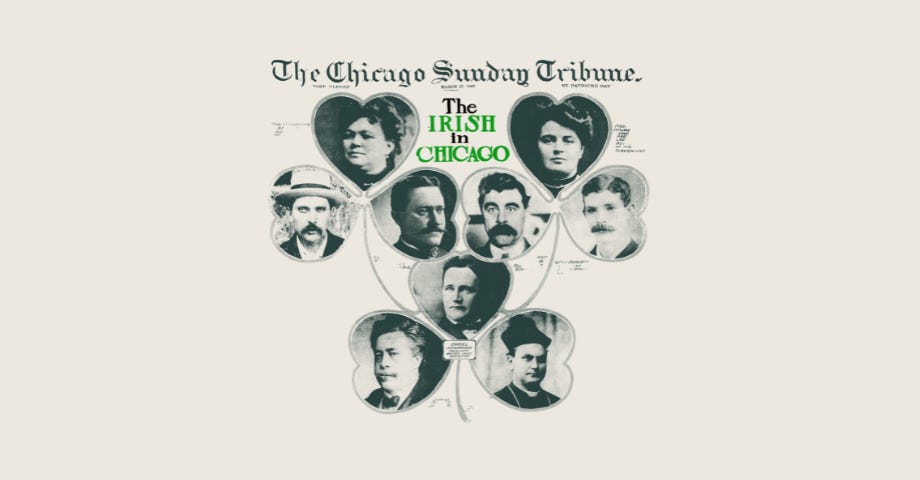
The first two major ethnic groups who came to Chicago from Europe were the Germans and the Irish. Their differences would define the city’s political landscape for a century.
First, the Irish spoke and understood English. Many Germans did not.
Second, the Irish were neutral bystanders in centuries-old feuds between central and eastern European groups. The Germans were not.
And third—as every Chicagoan can see firsthand this weekend—the Irish were drinkers. So were the Germans. But unlike the Irish, they didn’t own the saloons around which so much of the city’s social life was organized.
This all played out at the polls.
Of the 28 most influential Chicago aldermen of the 1890s, 24 were Irish.1 In 1926, 33 of the 50 ward committeemen for the Democratic Party were Irish.
And by 1970, despite constituting less than 10% of the city’s population, the Irish held the following leadership positions in local government:
Mayor of Chicago (held since 1933, ~40,000 patronage jobs)
President of Cook County (~6,000 patronage jobs)
Cook County clerk
Cook County assessor
Member of the Cook County board of appeals
Cook County state’s attorney
Clerk of the Cook County circuit court (~1,500 patronage jobs)
President of the park district
Corporation counsel for the city of Chicago
Superintendent of police
Fire commissioner
Superintendent of the public schools
President of the board of education
President of the Metropolitan Sanitary District
Purchasing agent for the city of Chicago
President of the Chicago Civil Service Commission
President of the Chicago Plan Commission
City collector
Cook County civil defense director
Commissioners of the departments of streets and sanitation, water and sewers, buildings, consumer sales, and weights and measures
25 of 66 Cook County circuit court judges
How? Simple. The patronage system.
“I mean, everybody wanted to be a ward committeeman. They knew the power of the patronage system,” former Illinois House Speaker Michael Madigan said in a 2009 interview granted as part of an oral history on Richard J. Daley.
“They wanted a job in the patronage system … I would tell them, ‘Yes, we can put you in a job. But you’re going to work for the Democratic Party.’”
The end of that system ultimately came from the courts. The Shakman Decrees, and decades of court monitors overseeing them, dismantled pure patronage hiring in Chicago and across Illinois.
Indeed, Madigan was the last Irish-Chicagoan political boss. He currently resides in a West Virginia prison, after being indicted on corruption charges.
The machine’s legacy
Chicago’s Irish machine is gone. No longer are tens of thousands of patronage jobs flowing to somebodys-that-somebody-sent.
But two mental models from the machine era remain dominant, and are worth highlighting.
There’s a division of the spoils in Chicago government along segregated racial lines. It is common for public officials to claim, in public, that certain elected offices “belong” to one racial group or another, including the city clerk, city treasurer, and powerful City Council committee chairmanships, to name a few. The unfair Irish dominance of public institutions for decades gives license to this behavior, which further divides an already hyper-segregated city.
The “where’s mine?” attitude in government persists. Politicians collude with government unions to leverage public resources for the advancement of their own power. Chicagoans see it when collective bargaining agreements with the police union override state law. They see it when 40% of the city’s budget goes toward pensions and debt, a hangover from decades of corrupt deals. They see it when the Chicago firefighters’ union, among others, actively works to make that problem worse. And they see it in the belligerence of Chicago Teachers Union leadership.
This St. Patrick’s Day, it’s worth considering what lawmakers can do to better balance that power, and truly end the machine.
Friendly reminder
Tuesday, March 17, is Election Day in Illinois. Haven’t voted yet? Here’s everything you need to know.
In the news
Whodunit?
I joined Fox32 to discuss why the Chicago Board of Education is wasting money on an investigation into how residents learned of a meeting to hike their property taxes.2
On a related note, the CTU just recorded record-low popularity. Just 27% of Chicagoans have a favorable opinion of the union. Here’s why.
Headlines that can’t happen here
San Francisco Mayor Daniel Lurie is pursuing major changes to his city’s charter, per ABC7:
“This system works for the insider. It’s bred corruption,” Lurie told reporters Wednesday.
If the measures qualify and are approved by voters, they would make significant changes to how San Francisco’s government is structured, how contracts are handled and how future ballot measures reach voters.
“Our city charter has grown so calcified and convoluted that it makes it harder for City Hall to respond to the needs of residents,” said Supervisor Rafael Mandelman, board president. “These measures take a practical approach to modernizing our government to be more accountable to the people it’s meant to serve, while maintaining strong checks and balances.”
Meanwhile, Chicago is the only big city in the country without a city charter.
And in Washington D.C., the City Council is suing the mayor, per the Washington Post:
The D.C. Council sued the mayor last week, seeking to force Bowser to deliver a host of budget documents prepared by agency directors that she has withheld for years —despite city laws, and a recent court ruling, requiring that she provide them.
Mendelson said in an interview Tuesday that the documents are critical to understanding the full scope of financial pressure points or program needs at each city agency, especially in a tough budget year in which cuts and difficult policy trade-offs are on the table.
Still, Mendelson downplayed the legal drama. It was “not a big deal,” he said, and can easily go away if Bowser hands over the documents. “We shouldn’t have to seek a court order,” he said.
Meanwhile, when Chicago’s mayor ignores city laws and the City Council, no one sues.
One reason is that Chicago lacks an independently elected city attorney, as seen in cities like Los Angeles and Columbus.
Another is that if City Council members were to sue the mayor, they would be forced to use the city’s corporation counsel, who reports to the mayor.
All the stats on Irish dominance of Chicago local government in this piece are per Rakove’s indispensable “Don’t Make No Waves…Don’t Back No Losers.”
This is an example of Gift Room Syndrome. So be sure to read why it really matters here.