


The Chicago Board of Education this week voted to pass a budget the district’s own CEO and CFO said was unbalanced.
Why?
The roll call offers a clue.
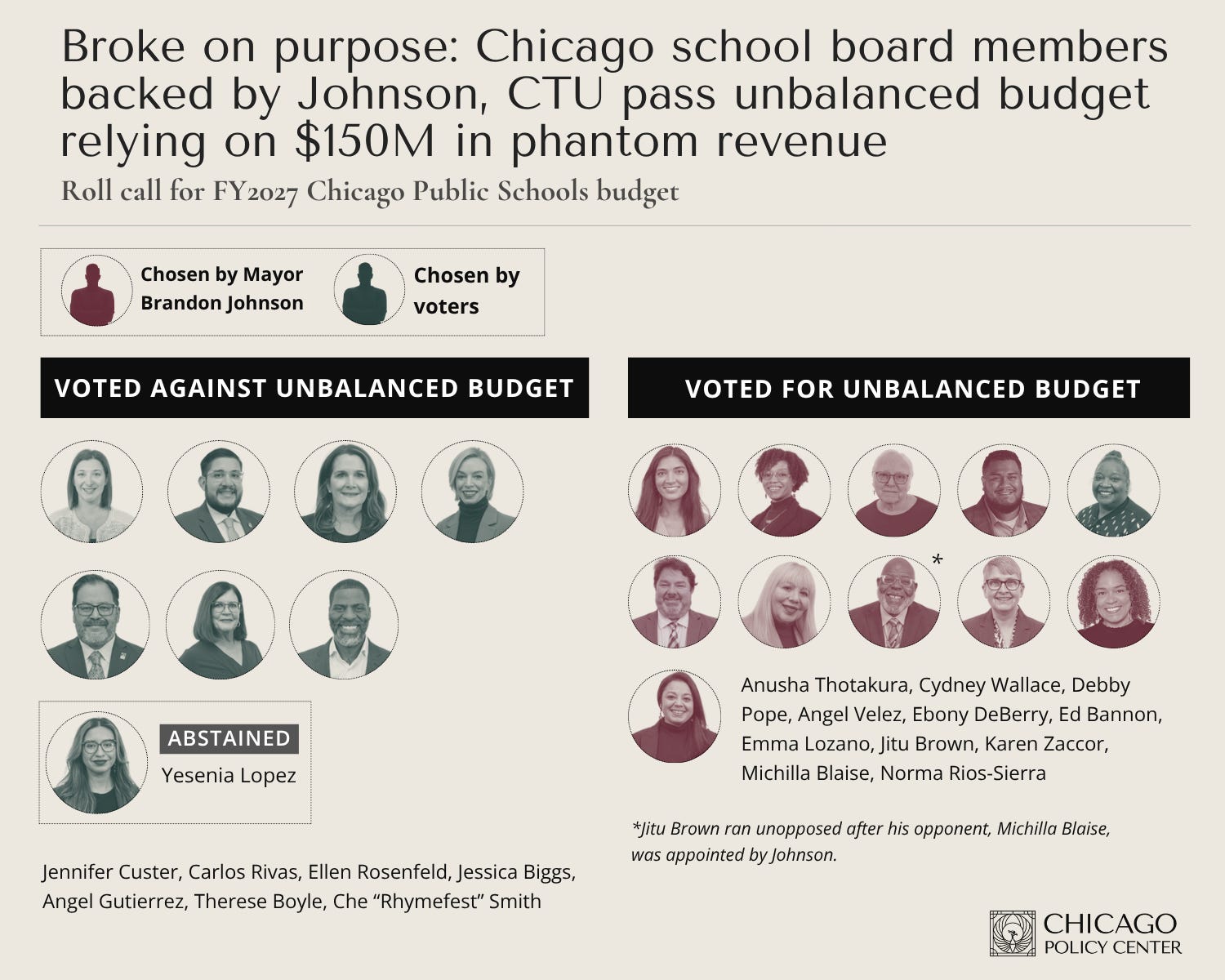
Of the eight members who voted against the budget or abstained, all were seated via competitive elections. But of the 11 members who voted yes, all but one were seated via Mayor Brandon Johnson’s appointment power.
Chicago voters will choose a fully elected school board for the first time in city history this November. Before reading any further, ensure you receive your ballot here.
The budget originally proposed by CPS CEO Dr. Macquline King balanced out in part through a combination of modest staff cuts and furloughs.
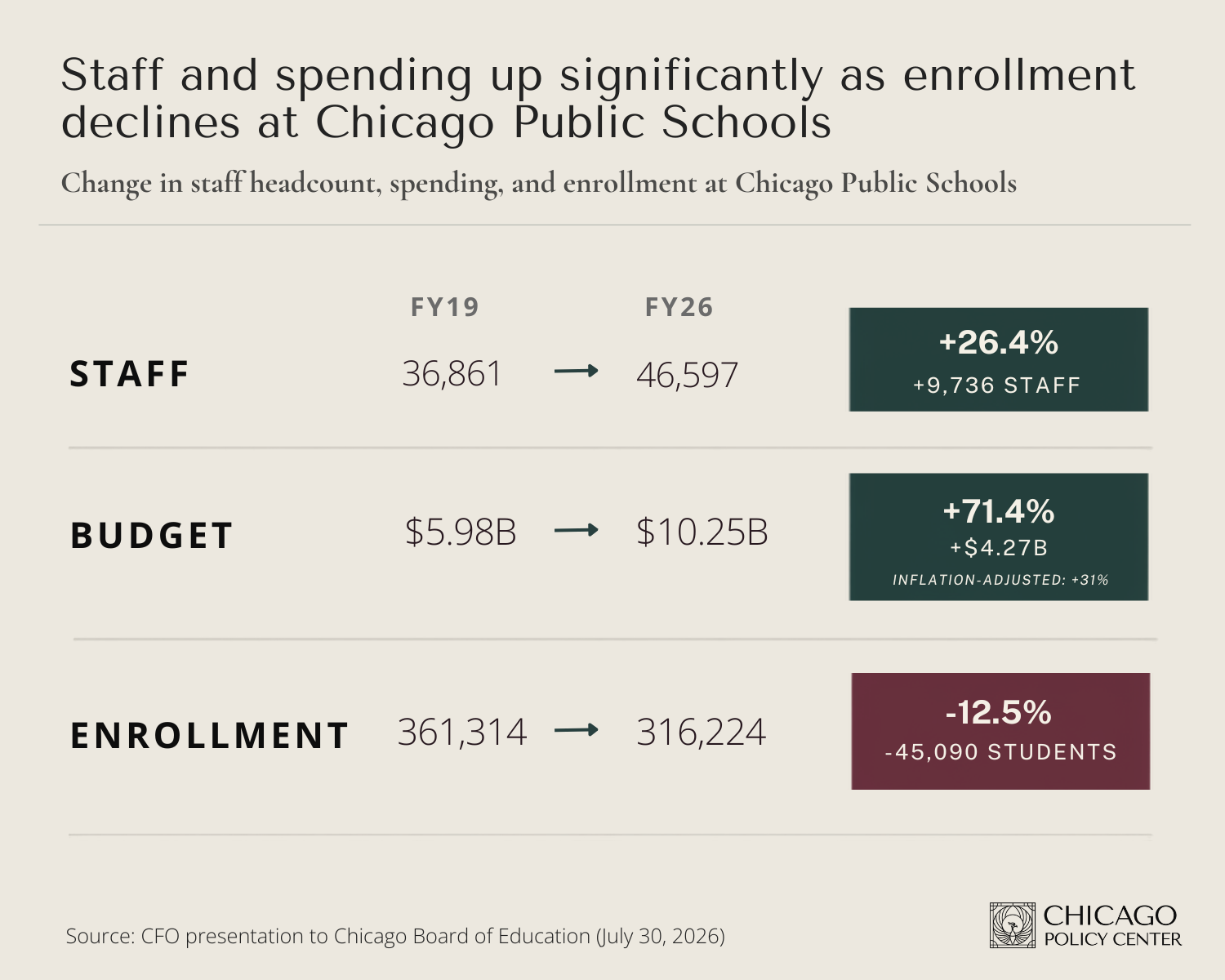
King’s restraint makes sense in a district that is currently a national leader in empty schools and junk bonds. Chicago Public Schools has added nearly 10,000 staff and $4.2 billion in new spending since 2019, despite enrollment dropping by more than 45,000 students over the same time period.
But board members backed by Johnson and the Chicago Teachers Union rejected King’s plan. Instead, they passed a nearly $10 billion budget that reversed some of those cuts by assuming an additional $150 million in state money out of thin air.1
King’s team was clear at the board meeting that this reckless budgeting would hurt the district’s reputation in the eyes of lenders, leading to higher borrowing costs or shutting the district out of the market altogether.2
That risk is especially serious as Cook County’s property tax delays are forcing CPS to borrow money immediately to fund teacher paychecks, which are scheduled to go out on Sept. 4.
King’s office told CPS families this unbalanced budget would jeopardize the start of the school year by threatening the district’s ability to borrow.3 In response, Johnson-backed board members sent King a scolding letter in which they claimed the budget was balanced and advised King to alter her communications with families. Meanwhile, CTU celebrated the vote.
But King was immediately proven right.
S&P Global Ratings Managing Director Jane Ridley said the district’s reliance on $150 million in unlikely funding shows the board did not address its “underlying structural imbalance.”
“The first thing we look at when evaluating a local government’s budget is whether it’s structurally balanced, and it’s clear from the budget approved yesterday by the Chicago Board of Ed that CPS continues to face a structural deficit,” Ridley said.
This budget vote was akin to setting the district’s house on fire and hoping insurance pays out. And that was by design.
Budget chaos is the point
During last year’s school budget fight I highlighted remarks from Chicago Teachers Union President Stacy Davis Gates on how the union wields political power.
“You have to create the crisis by which the boss…the government can no longer ignore you,” she said to an audience at the Netroots Nation conference.
Indeed, CTU leadership believes fomenting financial distress at CPS can create leverage to demand more money from Springfield.
Board member Michilla Blaise justified it this way in a Facebook post following the vote: “If we can’t come up with it, we will put all the layoffs and dead programs at the governor’s feet.”4
Blaise was appointed to the school board by Johnson and is running for election this November with CTU’s backing. We discussed district finances on WTTW’s Chicago Tonight in May.
My response to Blaise’s argument that the district’s financial woes can be solved through additional state aid:
I do want to talk about resources. I think it’s important to note that there has been a lack of a realistic plan to get additional resources from the state. Per-pupil spending has doubled over the last decade. It’s now $32,000 per student per year. But if we want to talk about those resources it’s important to note that City Hall has the worst relationship with Springfield of any mayor of the last 50 years. They have not been able to put forth a credible plan to get Springfield to move on this issue.
There are also hundreds of millions of dollars on the table for public school students in Chicago today if the state would just follow the example of Colorado Gov. [Jared] Polis and New York Gov. [Kathy] Hochul and opt into a new federal tax credit for education donations. That would send hundreds of millions of dollars to public school students in Chicago. But the Chicago Teachers Union and indeed Board Member Blaise have voted against that proposal. I think that is unconscionable. We need to get resources in the hands of students through private tutoring, services for students with special needs, [and that] can all be funded through private donations if we opt into this program.
Ironically, the CTU’s ruling caucus—the Caucus of Rank and File Educators, of which Gates is a member—formed in 2008 as a reading group focused on Naomi Klein’s “The Shock Doctrine,” a book that popularized the phrase “disaster capitalism.”
The book’s main argument is that bad actors take advantage of crises to push unpopular policies.
State lawmakers should refuse to be bullied by interests creating crises on purpose.
A better path forward
For the first time in city history, Chicagoans will be able to elect all 20 members of the school board and a board president in the Nov. 3 election.
And those board members have the opportunity to meaningfully improve the district through proven reforms that have worked for public-school families in other big cities. Those reforms can be found in the Chicago Policy Center’s CPS Excellence Agenda.
Make sure you receive your ballot to vote in that election here.
In the news
I joined the Mincing Rascals Podcast on WGN Radio to discuss the White House Correspondents’ Dinner, Rahm Emanuel’s presidential ambitions, city-owned grocery stores, and more (Apple Podcasts, Spotify). My “green light” recommendation: Sherman’s March (1986 film).
For at least three reasons, $150 million in additional state money is extremely unlikely to appear before the end of the year:
Approving new funding in the November veto session will require supermajority votes in the House (71 votes) and the Senate (36 votes). Springfield insider Rich Miller put the odds as follows: “Finding three fifths super majorities in both chambers to spend money the state doesn’t have on a Chicago only bailout would require a magic wand the size of the Hancock Building. And those don’t exist.” He is correct. A Chicago-specific funding package would require support from lawmakers outside Chicago in order to pass, which means any funding increase for CPS would need to come with hundreds of millions of dollars in additional revenue for interests throughout the rest of the state.
CTU cited a political pledge from Illinois House Speaker Emanuel “Chris” Welch to seek additional funding for CPS in the fall veto session as proof that new money is on the way. But Welch is currently under intense scrutiny from House Democrats for his his office’s mishandling of a former House staffer’s sexual harassment allegations against a fellow House member.
The CTU’s political muscle in Springfield is limited due to the behavior of some of its strongest allies. For example, Ald. Byron Sigcho-Lopez made threatening remarks directed toward Gov. JB Pritzker during public comment at last week’s school board meeting. The governor’s spokesperson responded. CTU is the alderman’s No. 1 financial contributor.
The district’s counsel was also clear during the meeting that deeming a budget “balanced” on highly speculative revenue could expose board members to personal liability. Stu Loren lays out some of the legal arguments for this here. Expect litigation on this point.
Via Paris Schutz at NBC 5: “Today’s amended budget threatens the District’s ability to secure the short-term financing (Tax Anticipation Notes) required to cover early September payroll. Our District must now present these modified terms to lenders, but market viability remains uncertain. Simply put: we cannot guarantee that CPS will receive financing in time for the September 4 payroll.”
Credit to Rich Miller for flagging this.
Why would you think that relying even more on federal money is the way to solve this issue when you’re seen the federal government using funding to extract political concessions and rule like a federal crown? Wake up. We have to solve our problems within the city and state.
How can Chicago possibly ask for more money with the recurring publicly about its maintaining numerous near empty schools at great unnecessary expense? The optics of signing such legislation would surely kill Pritzker’s chances for higher office.