


“Has your brand become toxic?”
This was a pointed question from WGN Political Editor Tahman Bradley, posed to Chicago Teachers Union President Stacy Davis Gates in a recent interview.
Her immediate response: “I don’t understand the question.”
When pressed, Gates added, “The Chicago Teachers Union is not a political party, it is a labor union.”
But internal union documents show CTU leadership is trying to skim $8.5 million more from teacher paychecks explicitly for politics, while trying to silence union members critical of Gates’ leadership.
Under the proposed dues hike, Chicago teachers would see up to $800 more per year flow from their paychecks to union coffers. The union already takes in more than $40 million a year, mostly from dues. And it spends less than 18 cents of every dollar on teacher representation.
The No. 1 reason for the proposed dues hike? Politics.
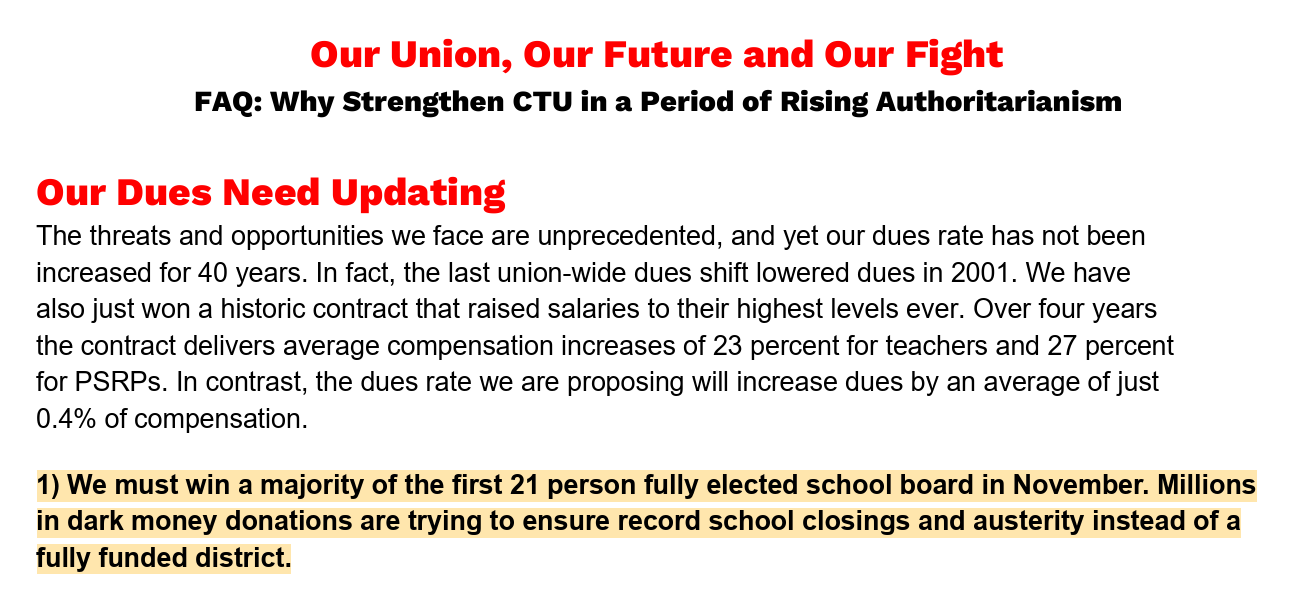
“We must win a majority of the first 21 person fully elected school board in November,” reads the first point in CTU’s member FAQ document.1
This directly contradicts CTU’s promise to members about how leadership uses dues money.
The official CTU handbook tells members that the union does not use dues money for politics, so if they are interested in funding political activity, they should consider voluntary donations to CTU’s political action committee.
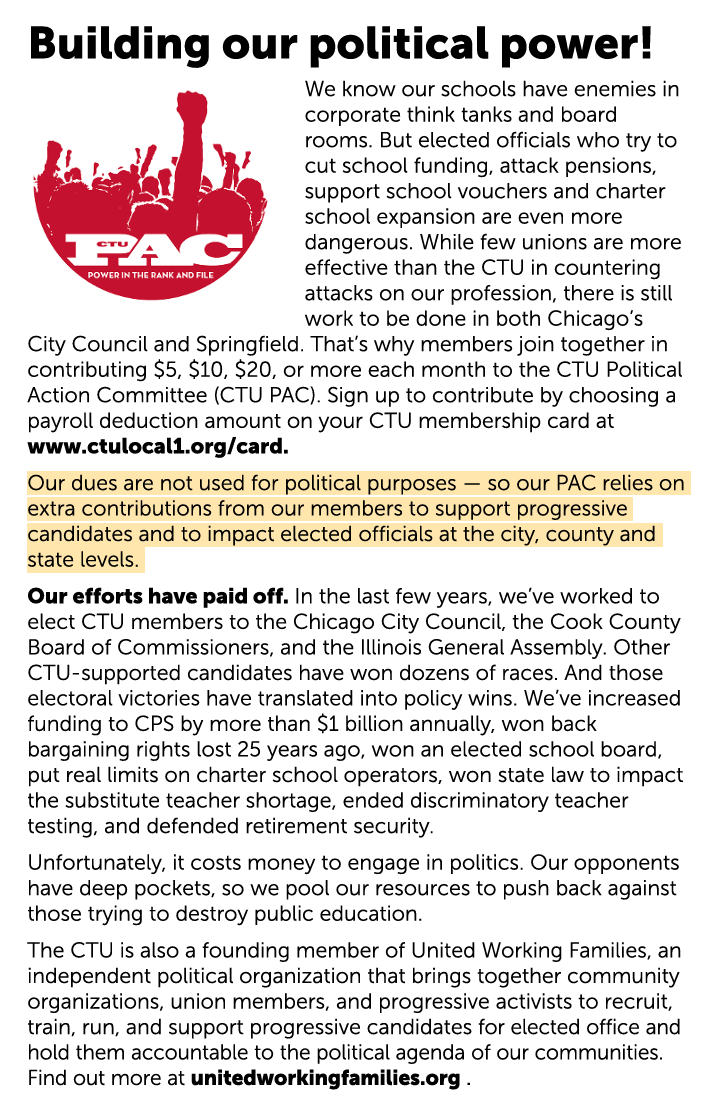
“Our dues are not used for political purposes,” according to the handbook. “So our PAC relies on extra contributions from our members to support progressive candidates and to impact elected officials at the city, county and state levels.”
This kind of double-speak is one reason members are concerned about another constitutional change slipped into the dues hike vote, which will take place on May 20-21: an attempt to stop members from holding the union accountable.
A proposed amendment to the union constitution tries to place limits on when members may bring a lawsuit against the union for violating members’ rights.
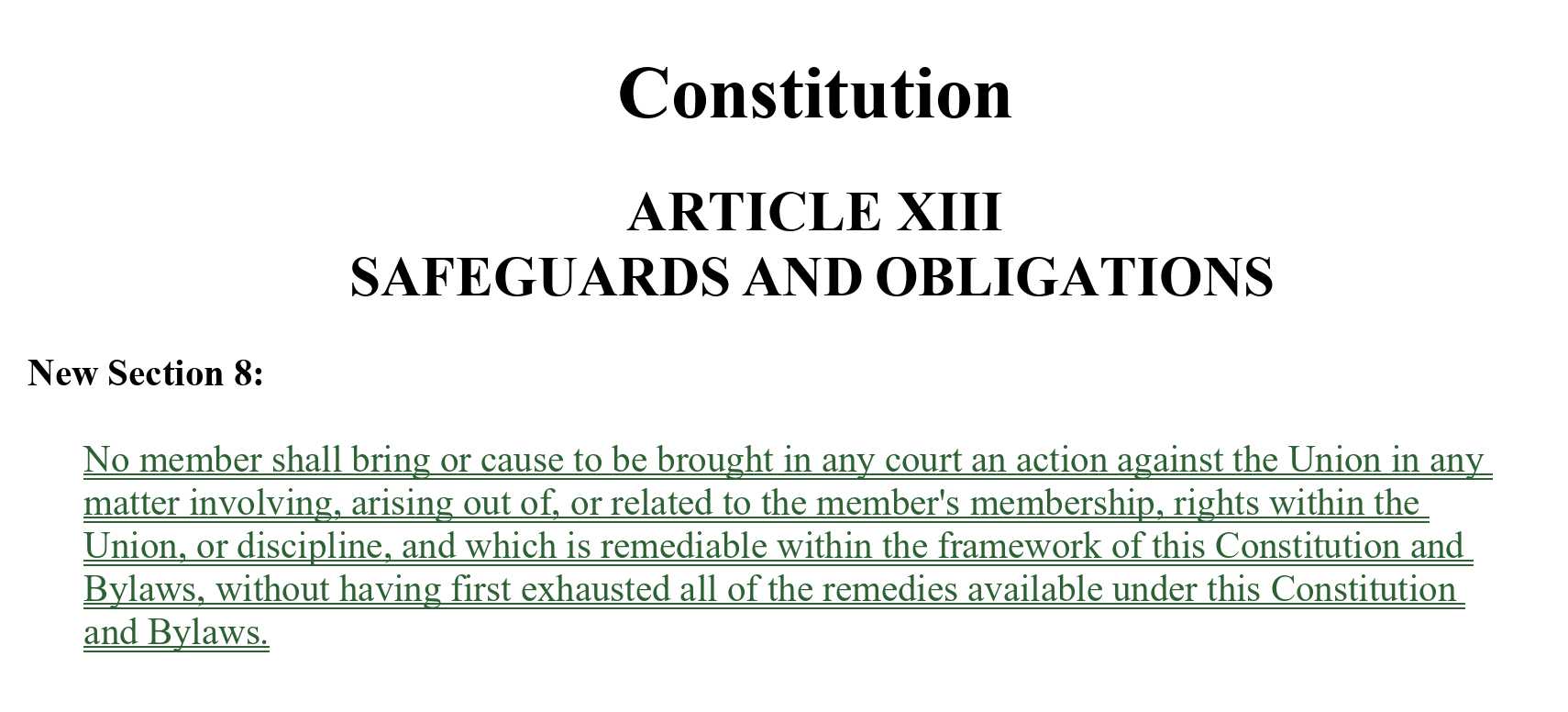
This provision is clearly a response to members’ lawsuit against union leadership regarding Gates’ years-long refusal to publish audited financial statements. The judge in that case has repeatedly denied the union’s attempts to dismiss it.
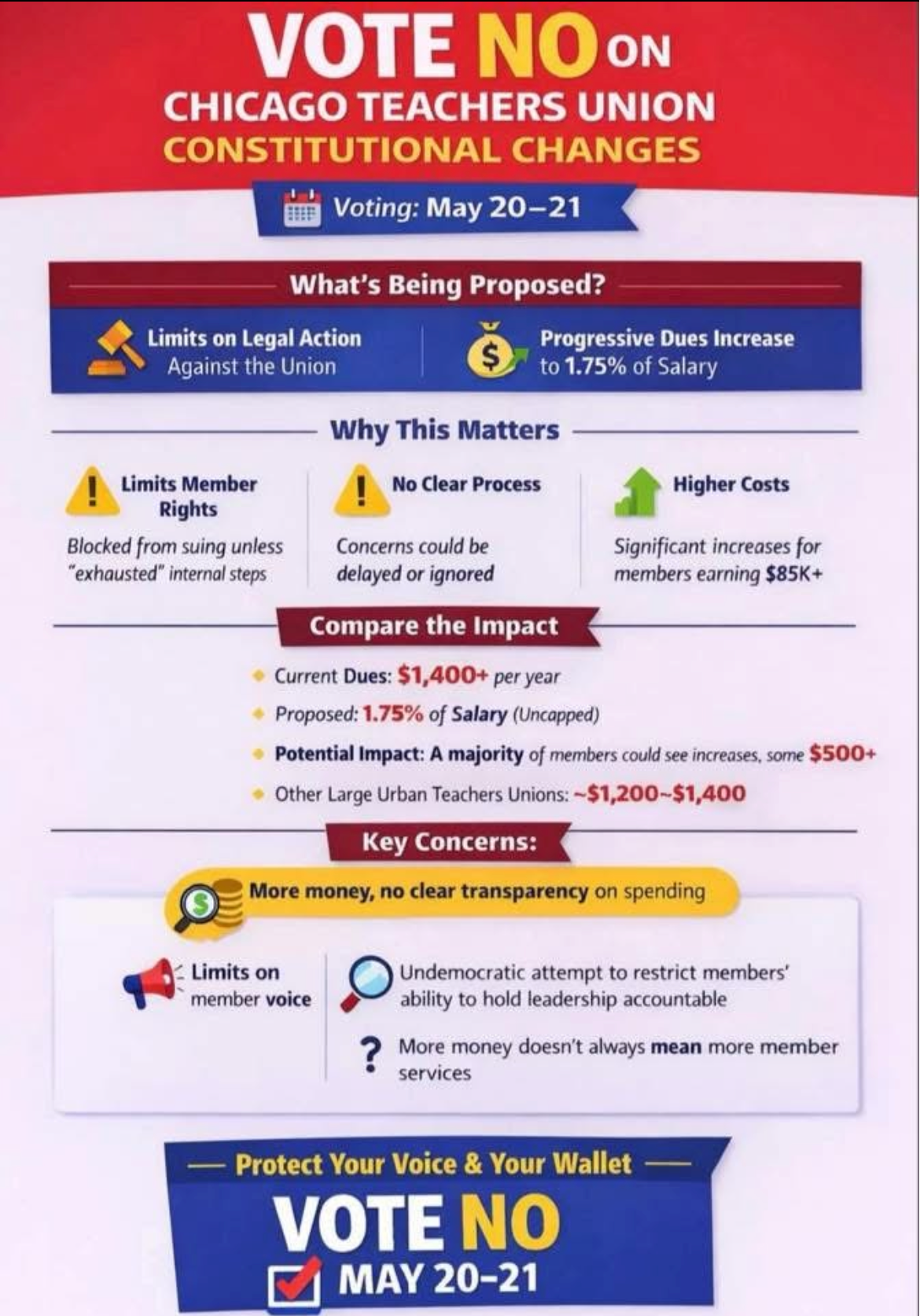
Teachers opposed to these changes have been circulating this flier, urging members to vote no.
What will CTU members get in return for millions of dollars in additional dues?
If the 2024 school board elections are any indication—not much.
Results of CTU spending on school board races
CTU leadership’s record on school board races may not inspire confidence among members.
A Chicago Policy Center analysis of a dozen affiliated PACs found CTU spent nearly $2.9 million on school board races in 2024. Of that spending, more than $2.1 million (75%) went to losing candidates.
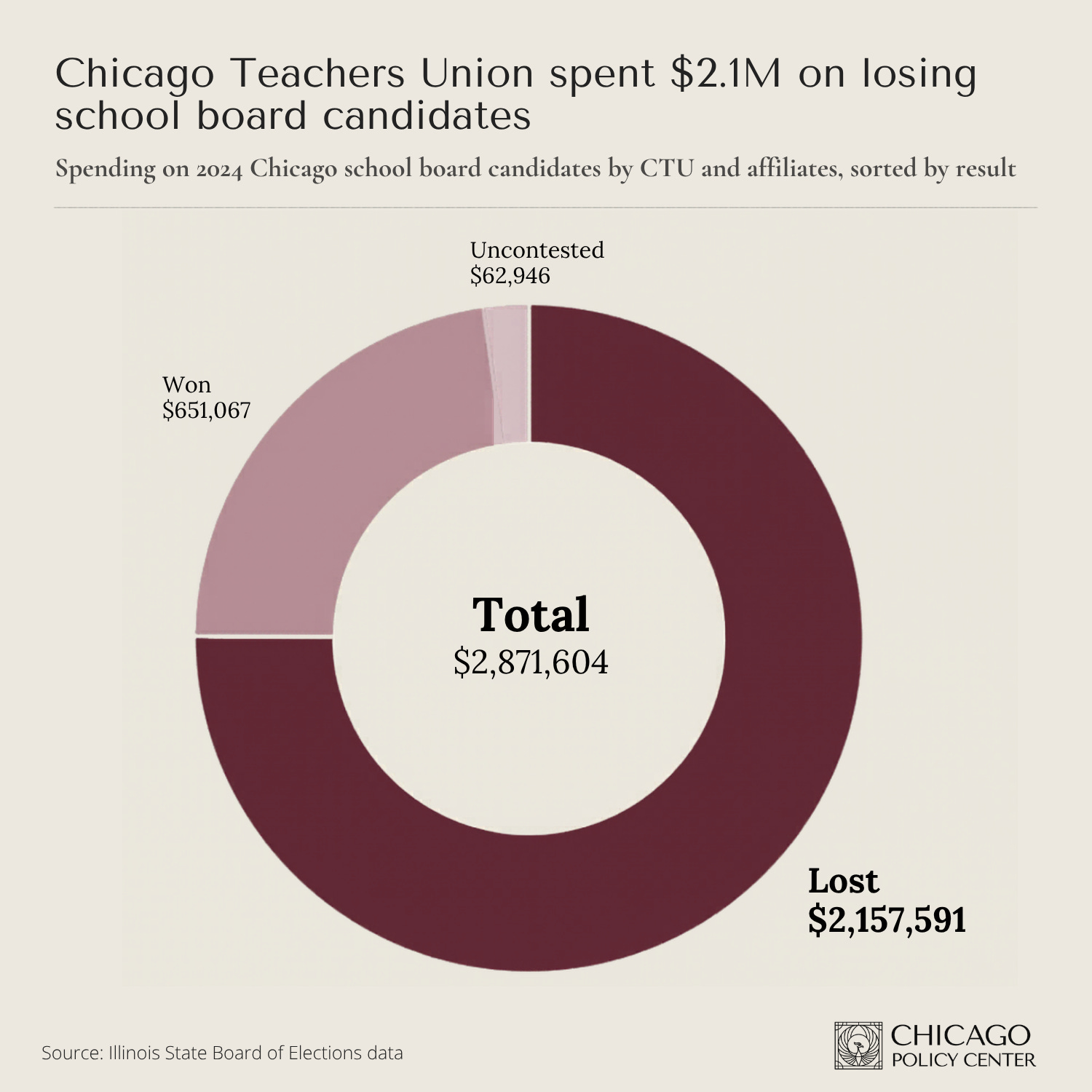
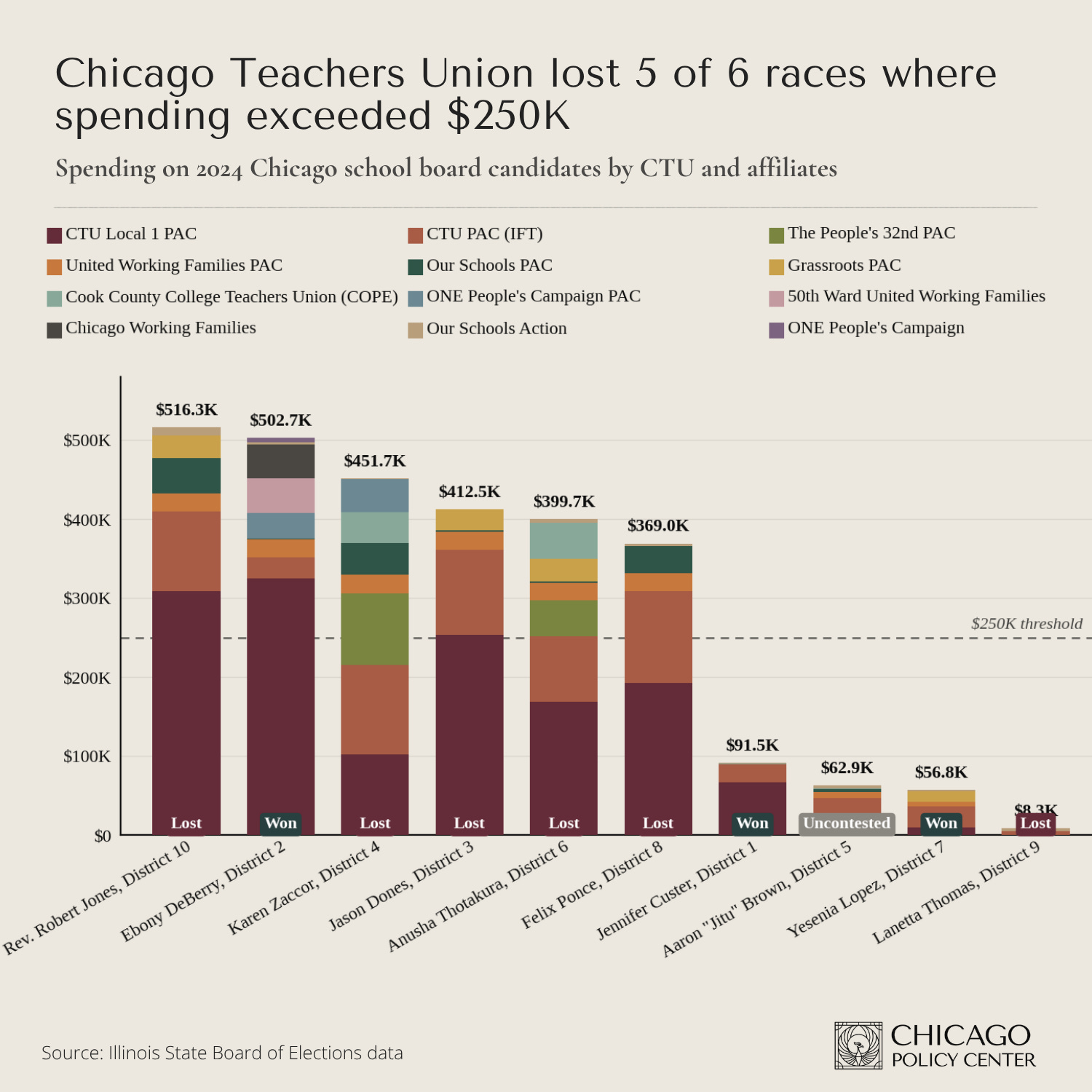
And while CTU-backed candidates lost six of the nine competitive seats overall, they fared worse in their biggest-spending races, losing five of six contests in which the union and its affiliates put up more than $250,000 for their candidate.
The Chicago school board elections take place Nov. 3.2
Is another $8.5 million enough to clean up a toxic reputation? Not likely.
In the news
Update on federal tax credit scholarship: Last week, Democratic New York Gov. Kathy Hochul said she plans to opt into the federal tax credit scholarship program. If Illinois Gov. JB Pritzker follows suit, Illinois could unlock $1 billion in donor money statewide for both public- and private-school students. If Illinois does not opt in, that money will flow to other states. The Last Ward reported in February on how Illinois Democrats could unlock at least $100 million in new resources for Chicago public-school students by opting in.
Update on the investigation into how Chicagoans learned about a meeting to hike their property taxes: The Last Ward reported in January on an absurd, taxpayer-funded investigation into how local media learned of a planned Chicago school board meeting to hike the district’s property tax levy. That investigation is now complete. Lawyers interviewed two dozen witnesses, and found nothing.
Update on Illinois’ muni debt crisis: My colleague Joe Tabor last week published a must-read piece in Crain’s Chicago Business about how Illinois recently rejected south suburban Harvey’s request to be designated a “distressed city.” The saga shows why the state must implement a better structure to assist insolvent local governments, including allowing for the option to pursue debt relief via Chapter 9 bankruptcy. The Last Ward reported in October on how Harvey is tipping the first domino in Illinois’ municipal debt crisis.
Mincing Rascals: I joined the Mincing Rascals podcast on WGN Radio to discuss the SAFE-T Act, the millionaires tax, and more. My “green light” recommendation: Force Majeure (2014).
Notably, the No. 2 reason cited is “resources to fund a state-wide millionaires tax campaign in order to fully fund the state’s school funding formula.” The constitutional amendment necessary to implement a progressive income tax in Illinois recently died in the Illinois House, meaning this question would not appear on the ballot until 2028 at the earliest.
Illinois law grants far too much power over local government to unelected officials like Gates. State lawmakers should fix that.
I'm not sure what constitutes a 'political funding' or 'political contribution' but how much of CTU political contributions are made through CTU directly or through CTU-PAC (Political Action Committee)? Or, what are the legal limitations for CTU to make political contributions vrs through CTU-PAC? It's my understanding part of the current lawsuit litigation by CTU members against CTU is that CTU has illegally transferred funds to CTU-PAC without members consent?
Per AI:
"The Chicago Teachers Union (CTU) Political Action Committee (PAC) operates as a separate segregated fund (SSF) established by the labor union to collect voluntary contributions for political activities. It is a political organization, not a 501(c)(3) charitable nonprofit, and donations are not tax-deductible."
--Maybe the same story with CTU-CTUF (Chicago Teachers Union Foundation)?
--Do other unions have separate PACs?