

Chicago City Council last week finalized six questions that will appear before Chicago voters.
But do those questions actually matter?
Let’s take a look.
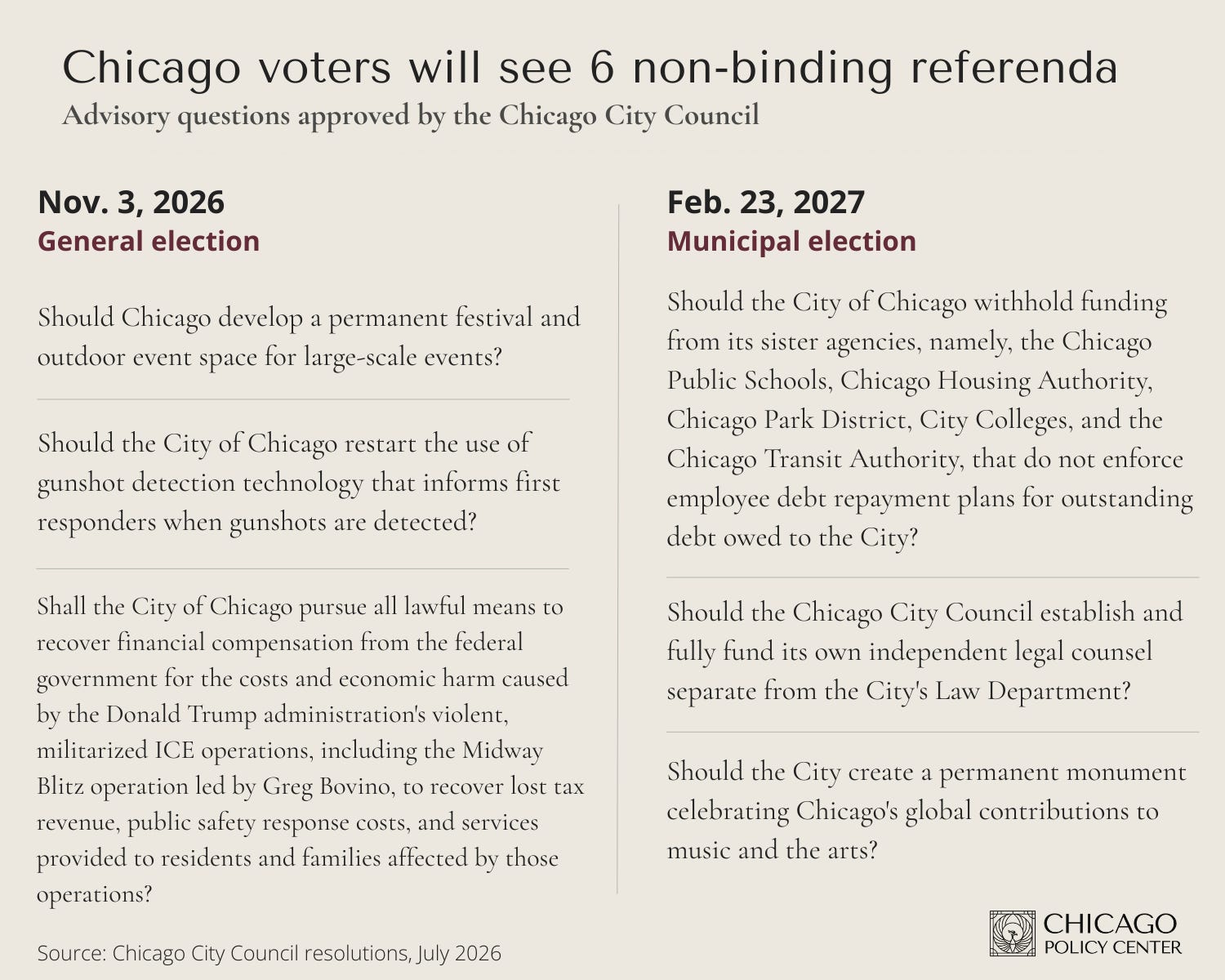
All six measures are non-binding, meaning they are essentially poll questions.
Media coverage on these questions highlighted how Mayor Brandon Johnson’s preferred non-binding referendum—asking voters to weigh in on whether the state should pursue a “millionaires tax”—failed to make it to the ballot.1 And in response, how Johnson berated City Council members.
Compare that political food fight to what New York City voters will decide on their ballots this November.
The day after Johnson’s push officially failed, New York City Mayor Zohran Mamdani’s charter revision commission (dubbed the Commission on Government Efficiency, or COGE) voted to put five binding propositions before voters that make changes to the city’s governance structure.
If approved, those structural changes will lead to faster approval for outdoor dining permits, streamlined city contracting, accelerated bike lane construction, a simplified building permit regime, and clear goals for the city’s rainy day fund.
In short: voters’ choices will actually matter.
Chicago discourages democracy
Lacking real options on the ballot is a symptom of a larger problem in Chicago. No other big city does more to discourage democratic participation in local government.
Here are five examples:
The rule of three: Non-binding questions can be useful. But in Chicago, they crowd out valuable ballot space. That’s because state law sets a “rule of three” in city elections, meaning only three referenda can appear at any one time.2 Lawmakers can use the rule of three to box out citizen-initiated referenda. So it’s no surprise Chicago voters haven’t decided a single issue on the ballot via citizen initiative in modern history.
Severely gerrymandered wards: Chicago politicians can pick their voters. Chicago City Council members, in concert with the mayor’s office, draw their own districts to reward friends and punish enemies.
February elections: Chicago is the only big city in the country that holds its municipal elections in February of an odd year. This timing suppresses voter turnout by 40%.
No city charter: Chicago is the only big city in the country without a charter. That means there is no mechanism nor civic culture for charter revision. Across the country, big-city charter revisions routinely offer voters the opportunity to decide serious governance matters.
Poor selection of elected offices: Chicagoans elect one citywide office that truly matters: the mayor. The other two citywide offices (clerk and treasurer) have very little authority. Unlike other big cities, Chicagoans do not elect an independent city attorney or chief financial officer.
And that final point isn’t just a city problem.
Chicagoans are now seeing the consequences of a similar dynamic at the county level on their property tax bills.
Too many cooks in Cook County
I joined WGN’s Ben Bradley this week for his story on Cook County’s failed property tax modernization effort.
The county has spent more than $63 million over the last decade attempting to update its property tax system. But that system is still broken. And delayed property tax collections are costing local governments tens of millions of dollars in short-term borrowing costs.
A new Cook County inspector general report found mismanagement of the project was a “perfect storm,” in large part due to the politicization of what should be purely bureaucratic offices.
From Bradley’s story:
The inspector general concluded that the transition to the new technology was imperiled by the conflicting agendas of elected officials and by a lack of cooperation from some officeholders…
The Chicago Policy Center‘s Austin Berg says the tech trouble is the perfect example of having too many cooks – or in this case, politicians – in the kitchen.
“Cook County needs an assessor. We need a board president. We need a clerk, but those don’t necessarily need to be elected offices that are completely separate and independent,” Berg said. “We saw here the result of that, just being a complete mess in trying to do something the county really needs.”
In the news
Quigley backs charter: U.S. Rep. Mike Quigley, D-Chicago, is running for mayor. He recently published a lengthy, detailed essay on why Chicago needs a city charter: “I Want to Be Mayor and I Want Mayors to Have Less Power.” Highly recommended.
The emptiest big-city school in the nation: I joined Good Day Chicago for a deep dive into last week’s edition of the Last Ward, which found Frederick Douglass Academy High School is the emptiest big-city school in the nation.
On the numbers:
The math is not math-ing. More full-time employees than students [and] almost double the number of classrooms as students at Frederick Douglass Academy. These statistics to the common person in Chicago are just shocking. The reason is that Chicago Public Schools has no framework, that is public, for what happens: what are the minimum standards for enrollment and performance at a school, and what are the high-bar standards that would trigger replication of a school? We lack a framework for both. In absence of that framework all we have in Chicago is a moratorium on school consolidation. So we don’t have a real plan. We simply have a big sign that says “no.”
On how empty schools hurt the district’s ability to get more resources:
The school district is in a position where it is increasingly needing to go to the state for additional resources. Imagine you’re a state lawmaker and a lobbyist comes to you saying we need more money for Chicago Public Schools. How can you feel good about that decision when you have a school spending $93,000 per student per year and it’s only 3% utilized. The emptiest big-city school in the country. It hurts the district’s ability to advocate for itself at the state level.
On the mayor’s preferred solution:
Mayor Brandon Johnson and the Chicago Teachers Union, when faced with questions about under-enrolled schools like this, they point to a model called the Sustainable Community Schools model, which is more about providing additional staff and additional wraparound services at schools. The problem with that model is at the eight high schools that have used [it] since 2018, we see proficiency is down, enrollment is down, absenteeism is up, and spending is up.
On our CPS Excellence Agenda:
We’re calling for a Blue Ribbon Commission [on facilities planning] from the newly elected school board in November that can actually build a framework for how we properly use our facilities to better serve students.
City housing debate: Housing reform is a key component of the Chicago Abundance Agenda. Veteran City Hall reporter Fran Spielman convened a fantastic housing debate last week between Zoning Committee Chair Ald. Gil Villegas (36th Ward) and Chicago Housing Commissioner Lissette Castañeda.
It appears Johnson’s push for the question on the 2027 ballot was purely a get-out-the-vote tactic to help his re-election efforts, given: All Illinois voters just saw a similar non-binding question on the November 2024 ballot, Cook County already has this question on its November 2026 ballot, and state lawmakers could not put a millionaires tax constitutional amendment on the ballot until 2028 at the earliest.
Former Gov. Pat Quinn had sufficient signatures to get two referenda on the 2018 city ballot: term limits for the mayor and an elected consumer advocate. Voters saw those question on their ballots, but a judge later ruled that only the three referenda approved by City Council would count. I asked Quinn if he knew of the last time a citizen-initiated referendum appeared on the city ballot. His response: “I don’t believe a voter-initiated referendum has appeared on the city of Chicago ballot under the 1970 Illinois Constitution. In 1986, a voter-initiated referendum for non-partisan city elections was ruled off the ballot by the Illinois Supreme Court (Lipinski v. Chicago Board of Elections). In 2018, the Circuit Court kept the mayoral term limits off the ballot. To my knowledge, those are the only two city voter initiative petition drives to have collected enough signatures to qualify for the ballot before court action.”
Although bad requirements and scope creep were probably the top reasons for the delayed property tax site, I see that other cities have had trouble with Tyler. Sadly, there are tech companies in Chicago that could have handled it.