


A Juneteenth celebration in Roseland ended in a mass drive-by shooting that left at least 14 people wounded.
It was the most horrifying moment in a stretch of violence that has pushed Chicago’s 2026 homicide count 8% above last year’s pace. Backsliding on what had been, until recently, an encouraging trend.
Days later, Mayor Brandon Johnson signed Executive Order 2026-3, establishing the Mayor’s Office of Gun Violence Reduction.
Here’s the problem: Chicago already has at least eight overlapping entities with some claim to police accountability or public safety coordination. And this executive order adds three more: the Office of Gun Violence Reduction, an Interdepartmental Gun Violence Reduction Cabinet, and a 17-member Gun Violence Reduction Advisory Council.
The executive order runs 11 sections and more than 1,500 words. But nowhere does it provide clear lines of authority between the new office and the bodies already in existence.
In fact, it gives the deputy mayor of community safety—who leads the mayor’s existing Office of Community Safety—a second, new role as executive director of the gun violence reduction office.
The root cause of Chicago’ public safety challenges has never been a lack of political bodies.
It’s the city’s failure to back professional solutions.
Chicago isn’t solving enough murders
Richard Day’s essential analysis last week at A City That Works shows the cost of Chicago’s poor police governance.
Fewer than one-third of homicides committed in Chicago in recent years have resulted in timely prosecution, compared to more than 80% in New York City.
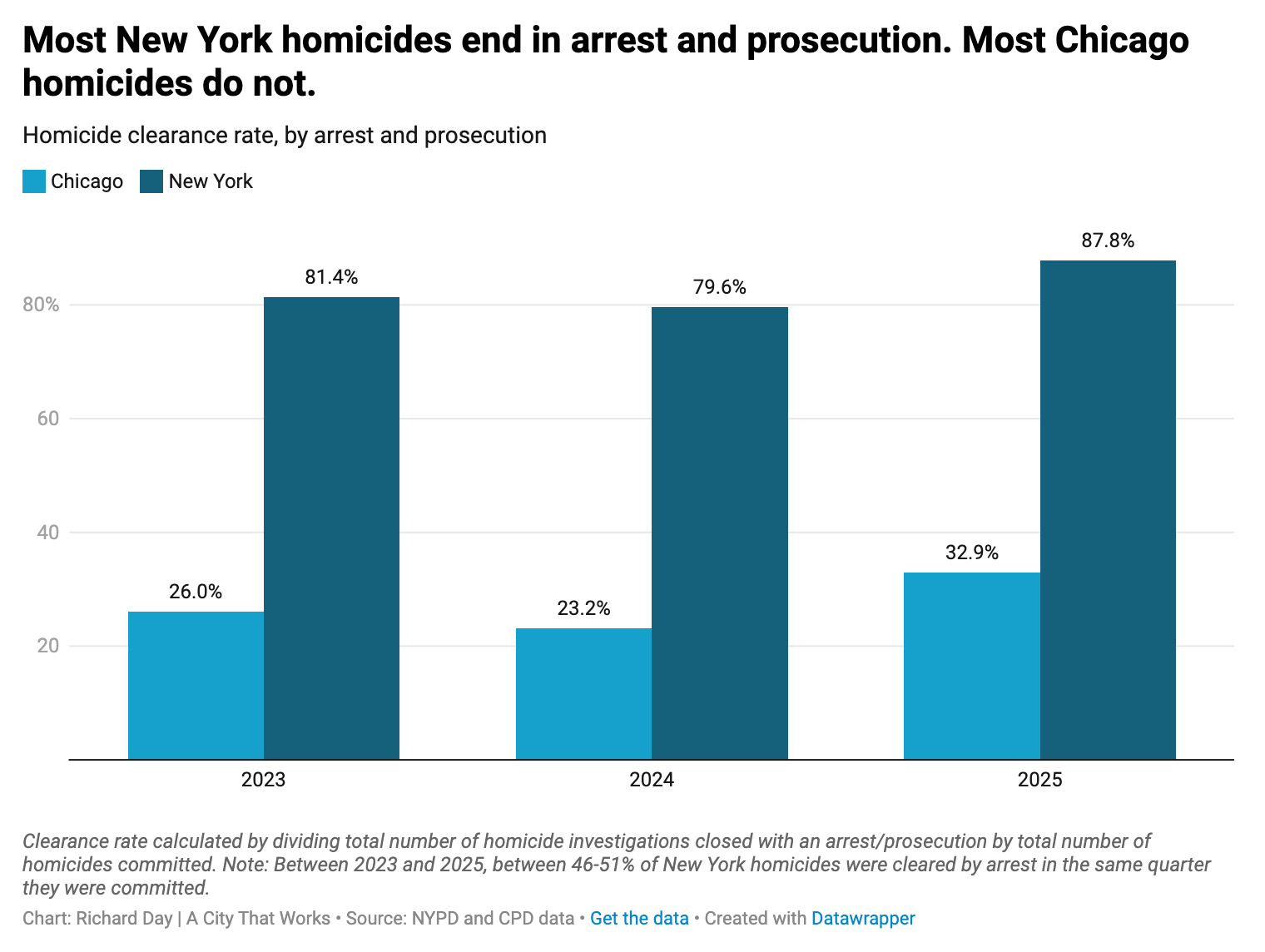
Closing that gap requires witnesses willing to come forward. And witnesses come forward when they trust officers working their neighborhoods. So how does the city build trust?
Chicago doesn’t need to look far for answers. In fact, the analysis is done.
How to bring professional excellence to the Chicago Police Department

Chicago Bears Head Coach Ben Johnson went viral last year for his call to greatness.
A 770-page workforce allocation study and a 167-page community policing assessment published earlier this year provide clear recommendations to improve community policing, such as beat integrity, consistent supervisory relationships, and ensuring officers have time for police work beyond chasing the radio.
But Chicago lacks the governance structure to quickly implement and monitor progress on these recommendations. In part because there are too many cooks in the kitchen. Compare that to Los Angeles, a city 50% larger than Chicago, which manages its police department through one primary, civilian-led body: the LA Police Commission.1
Chicago’s political instinct on public safety, every time something goes wrong, has been to add a body. The result is a city with a laundry list of public safety entities but just one in three murder cases ending in a prosecution.
Building a safer Chicago requires the bravery to break old habits, pick our heads up, and look around.
In the news
Mincing Rascals: I joined WGN Radio’s Mincing Rascals podcast to discuss the new Office of Gun Violence Reduction, the World Cup, and more (Apple Podcasts, Spotify).
More funding for Chicago students: Chicago public school families stand to gain at least $100 million a year in new education resources if Illinois Gov. JB Pritzker opts into a new federal tax credit program. I joined Patrick Pfingsten on WMAY to discuss.
Waiting for Superman: Civic Federation President Joe Ferguson invoked Chicago’s “waiting for Superman” syndrome in an excellent Crain’s piece on how City Council can govern itself more independently and effectively.
Digital asset transaction tax: I wrote last week on why Illinois’ new tax on digital asset transactions hurts Chicago. State Rep. John Cabello has now filed a bill to repeal the tax. Tell your state lawmaker to support the repeal here.
Sitting on the board are five unpaid commissioners appointed by the mayor and confirmed by LA City Council. Reporting to them are the chief of police, an executive director, a small staff, and the Office of Police Inspector General. Notably, LA residents in November will vote on a proposed amendment to the city’s charter that would give City Council more influence over the police commission.
Another obvious example of bureaucratic nonsense. Another layer of government with government employees with government pensions with zero measurable metrics to validate success, and will continue ad infinitum since government will never ever use zero based budgeting. It will be ‘baked into’ the next budget.
Validates the saying “Ah, good enough for government work” for a below average product or service. Learned that from my grandfather and father in the 60s!!
It could be worse we could be in Canada where close to 22% of its population are government employees (14.5%, US).